The Mystery of Dark Oxygen on the Ocean Floor
Andrew Sweetman and his colleagues were studying a seafloor about four kilometres beneath the Pacific Ocean, where animals and microbes consume oxygen. Yet the oxygen recorded by their instruments kept increasing. Sweetman,…
Andrew Sweetman and his colleagues were studying a seafloor about four kilometres beneath the Pacific Ocean, where animals and microbes consume oxygen. Yet the oxygen recorded by their instruments kept increasing. Sweetman, a marine ecologist at the Scottish Association for Marine Science, initially suspected that the sensors were faulty, but the unexpected readings continued across years of fieldwork. [1]
On 22 July 2024, the team published evidence of “dark oxygen” production and proposed that mineral deposits might help generate oxygen without sunlight. [2]
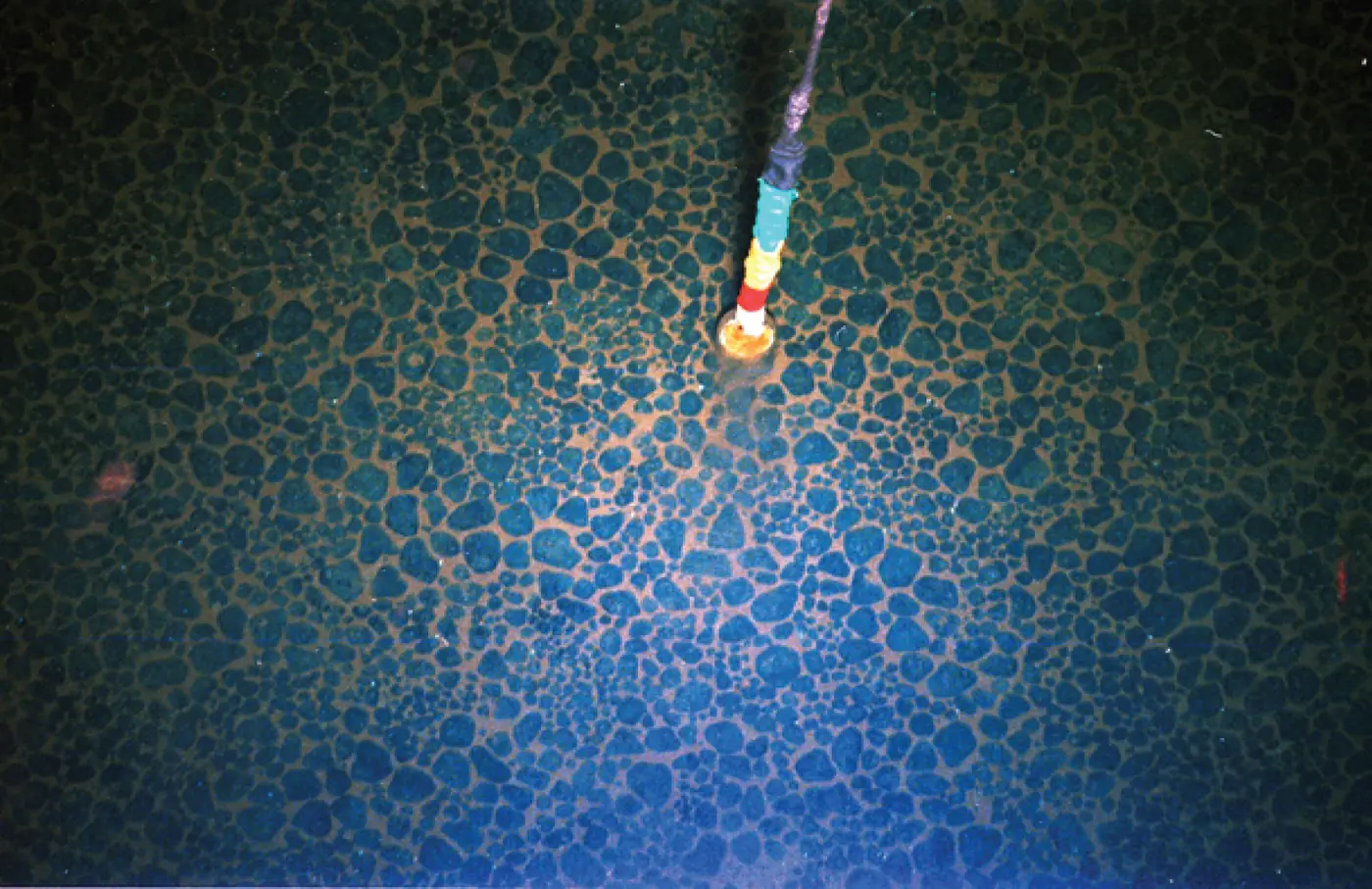 Nodules photographed off the Cook Islands in 2000 illustrate the kind of mineral-covered seabed involved; this is a different location from the study sites.
U.S. Geological Survey / Public Domain
Nodules photographed off the Cook Islands in 2000 illustrate the kind of mineral-covered seabed involved; this is a different location from the study sites.
U.S. Geological Survey / Public Domain
What Is Dark Oxygen?
“Dark” refers to the conditions in which this oxygen appears to form. Sunlight does not reach these depths to power photosynthesis, the process by which plants and algae release oxygen. Any local production would therefore have to occur through another process. [3]
Oxygen already reaches the deep ocean from above. Surface waters acquire it through contact with the atmosphere and photosynthesis; when cold, oxygenated water sinks, circulation carries that supply into the depths. Organisms consume the dissolved gas as they respire, so the balance between delivery and consumption helps determine how much remains available. [4]
Oxygen on the seabed was not itself unexpected, since circulation already carries it down from the surface. What puzzled the researchers was its increase inside their experiments. They had expected organisms to consume oxygen and its concentration to fall, but something appeared to be adding more.
The measurements were taken in the Pacific's Clarion–Clipperton Zone, where polymetallic nodules occur on the seabed. [3] These mineral deposits contain manganese and iron compounds, along with nickel, copper and cobalt. The metals have attracted interest in deep-sea mining, while their chemistry could also help explain the oxygen readings. [5]
The Readings That Kept Returning
To measure oxygen changes, the team placed chambers over patches of seabed, enclosing sediment, nodules and the water above them. In some experiments, oxygen concentrations climbed to more than three times the surrounding level over roughly two days. [2]
To check whether an instrument error explained the result, Sweetman’s team used an independent chemical method. It also indicated an oxygen increase, making an error specific to the original sensors less convincing. [1]
In separate incubations of recovered material, oxygen production appeared when nodules and seawater were present. This led the researchers to look more closely at the minerals, although the association alone did not explain how oxygen might be produced. [2]
The Seafloor Battery Hypothesis
Nodules consist largely of manganese oxides and iron compounds that accumulate other metals as they form. [5] Since electrical behaviour depends on chemistry, the researchers considered whether this mixture could allow a nodule to act like a natural battery.
The process they proposed was seawater electrolysis. With sufficient electrical energy, water can be split to produce hydrogen and oxygen. Northwestern University chemist Franz Geiger and his colleagues tested recovered nodules and measured electrical potentials reaching 0.95 volts across parts of their surfaces. [1]
For comparison, the team’s July explanation used roughly 1.5 volts—the voltage of a typical AA battery—as an illustration of the voltage needed for seawater splitting. The individual readings fell below that comparison. The researchers suggested that arrangements of nodules might increase the available voltage, drawing an analogy with batteries connected in series. [1]
If the nodules could supply the required electrical energy, this would offer a possible explanation for oxygen production. Measuring a voltage, however, does not demonstrate that the reaction occurs. The authors presented electrolysis as a hypothesis, leaving questions about its energy source and how long the process could last unresolved. [2]
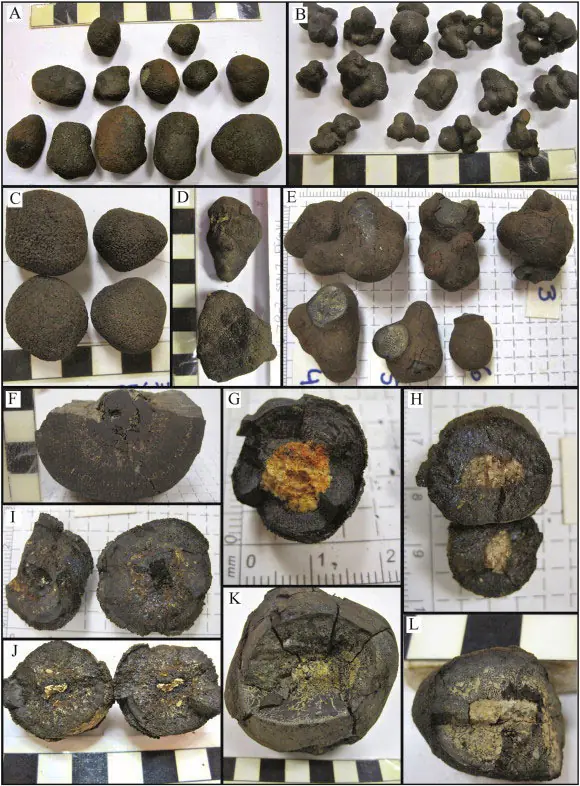 Whole and sectioned nodules from the Cook Islands show their varied shapes and internal structure. These photographs illustrate the material discussed in the study.
U.S. Geological Survey / Public Domain
Whole and sectioned nodules from the Cook Islands show their varied shapes and internal structure. These photographs illustrate the material discussed in the study.
U.S. Geological Survey / Public Domain
The Stakes for Seabed Life
Mining would remove the nodules being investigated as a possible oxygen source. Their metals are sought for batteries and other technologies, but removing them could also affect the surrounding environment. [5] Understanding their function on the seabed is therefore part of assessing the consequences of extraction.
Their role as habitat was already established before the dark-oxygen announcement. Nodules provide firm surfaces on otherwise soft sediment, allowing organisms such as sponges to attach. Those animals, in turn, support other species. Research published in 2021 modelled these relationships in Pacific nodule fields and found that removing the nodules could disrupt ecological networks and reduce local biodiversity. [6]
If nodules produce oxygen, extraction could also change a local supply. Sweetman called for assessments of both nodule removal and sediment settling over them during mining. [3] However, the evidence available in July did not quantify how much of this oxygen seabed animals receive. Its ecological importance would depend on that contribution and on whether production continues reliably under natural conditions.
The Questions Still Open
The researchers cautioned against applying their results to vast areas or long periods because oxygen production varied and might not continue steadily. Before estimating its contribution to the ocean's oxygen supply, they would need to establish where it happens naturally and how long it lasts. [2]
The possibility of oxygen production without light also led Sweetman to question where oxygen-breathing life could have developed. [3] Present-day measurements cannot tell us when a similar process first occurred or whether early organisms relied on it, so that remains a possibility to investigate.
Understanding what happens outside the chambers will require identifying the reaction, measuring how long it continues and determining whether nearby organisms use the oxygen. Those observations would connect the proposed chemistry to seabed life and help establish how much the finding changes our understanding of the deep sea.
Sources
- Deep-ocean floor produces its own ‘dark oxygen’
- Evidence of dark oxygen production at the abyssal seafloor
- Deep-sea discovery calls into question origins of life
- Hold Your Breath!
- Deep-ocean polymetallic nodules as a resource for critical materials
- Polymetallic nodules are essential for food-web integrity of a prospective deep-seabed mining area in Pacific abyssal plains