The Cicada Emergence and Its Ripple Effects Through Food Webs
In spring 2024, periodical cicadas emerged across parts of the central and eastern United States as two broods reached the end of their underground development. Brood XIII followed a 17-year cycle, while Brood XIX followed a…
In spring 2024, periodical cicadas emerged across parts of the central and eastern United States as two broods reached the end of their underground development. Brood XIII followed a 17-year cycle, while Brood XIX followed a 13-year cycle. These particular broods had last emerged in the same year in 1803. Their return brought a brief abundance of insect food to the landscapes where they appeared.[1]
Even organisms that never eat a cicada can be affected by the emergence. If predators spend more time eating this newly plentiful food, their usual prey may experience less pressure from hunting.[2] Uneaten cicadas eventually die, supplying decomposers with material that can later support plant growth.[3] An emergence can therefore change a food web both through what animals eat and through the nutrients passed between organisms.
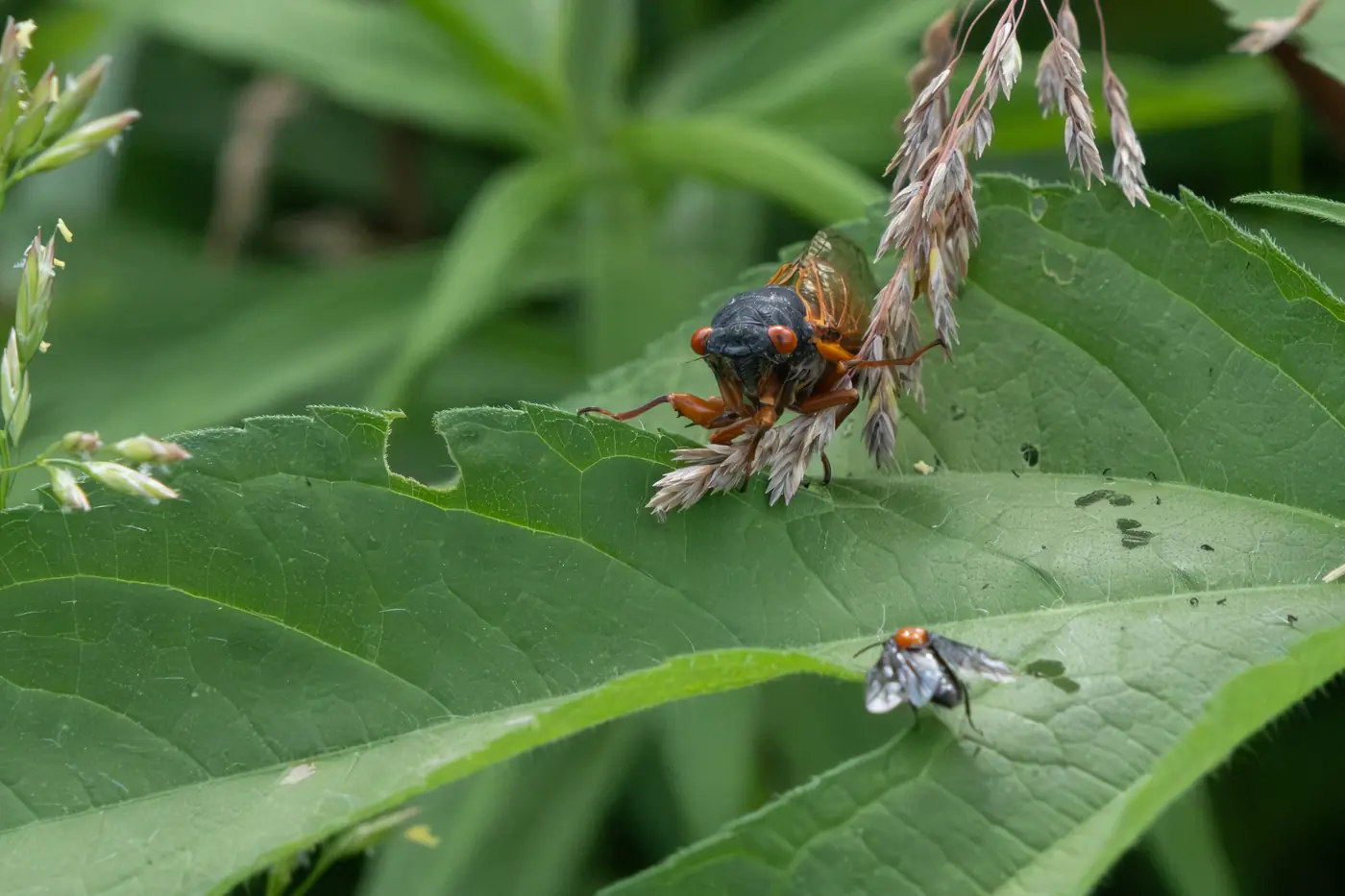 A Brood XIII cicada photographed at Danada Forest Preserve near Naperville, Illinois, in June 2024.
Credit: Zlew42 / Wikimedia Commons, CC0 1.0.
A Brood XIII cicada photographed at Danada Forest Preserve near Naperville, Illinois, in June 2024.
Credit: Zlew42 / Wikimedia Commons, CC0 1.0.

The 2024 Cicada Emergence
Although the two broods shared a calendar year, they largely occupied different places. Brood XIII occurred in parts of Illinois, Iowa, Indiana, and Wisconsin, while Brood XIX extended across a much broader southern and central range. A brood groups periodical cicadas by their emergence schedule and can include several species.[4]
Since the broods largely appeared in different places, their emergence in the same year did not give every affected woodland twice its usual number of cicadas. Instead, different regions received pulses of food, with the local effects depending on where cicadas actually appeared.[1][4]
For most of their lives, the cicadas had fed underground on fluids from plant roots. Once they emerged, animals above the soil could eat the living material accumulated during those years. In a short period, insects that had been largely hidden from these consumers became available in enormous numbers.[5]
A Sudden Feast for Predators
A large, temporary increase in food or nutrients is called a resource pulse. Cicadas provide both, first as living insects that animals can eat and later as remains that support decomposers. Which organisms use this material helps determine how the pulse moves through the food web.[6]
Birds and other predators can eat many cicadas without consuming the entire emergence. This is the principle of predator satiation: synchronized abundance exceeds what predators can eat, allowing many cicadas to survive long enough to reproduce.[5]
Predators can change their diets to take advantage of the abundance. As they spend more time eating cicadas, they may spend less time hunting other prey, extending the effects of their feeding choices to animals they leave alone.
The Connection Between Birds, Caterpillars, and Trees
One of the clearest demonstrations came from the 2021 emergence of Brood X. Research published in 2023 documented more than 80 bird species incorporating cicadas into their foraging. As birds shifted their attention, caterpillars experienced less predation. Caterpillar densities and the accumulated leaf damage they caused on the studied oak trees approximately doubled.[2]
Birds, caterpillars and leaves form three connected feeding levels: birds eat caterpillars, and caterpillars eat leaves. When birds have another abundant food source, they exert less control over caterpillars, allowing more leaf feeding. This spread of effects between feeding levels is called a trophic cascade. An oak tree can consequently lose more leaf tissue because birds nearby are eating something else.
The earlier Brood X event helps explain what could happen during the emergence in 2024, although the measured doubling cannot be assigned to every forest occupied by Broods XIII and XIX. The experiment established that an emergence can benefit other insects indirectly while increasing the pressure those insects place on plants.
Nutrients Returning to the Forest
Cicadas that escape predators eventually die, and their bodies provide food for decomposers. As decomposers break down this organic material, some nutrients become available again. Experiments using periodical cicada remains found increases in soil microbial biomass and nitrogen availability, along with effects on the growth and reproduction of forest plants.[3]
The disappearance of adult cicadas therefore does not immediately end their effects on the forest. Material from their bodies can pass into microorganisms and support plants through nutrient cycling, continuing the transfer of food through interactions that are less visible than predators eating insects aboveground.
Some plant responses can persist beyond that initial nutrient input. In a three-year experiment involving 100 American sycamores, fertilization with cicada remains increased tree growth in the emergence year. Differences in tree size remained detectable at least two years later.[7]
A brief addition of nutrients can therefore leave a difference in plant size that lasts, although the result does not mean every tree receives the same growth benefit. Nor can that benefit simply be weighed against the leaf damage caused by caterpillars. The two pathways were studied under different conditions, so combining them would not give a reliable balance for every forest.
Food Webs Beyond the Forest Floor
When cicadas fall into woodland ponds and streams, they carry material from the forest into an aquatic habitat. Organisms in the water can consume the remains directly or use nutrients released during decomposition, gaining access to a resource produced outside their own habitat.[6] In this way, the emergence connects food webs across the water's edge.
An investigation of the 2004 Brood X emergence measured cicada deposition in southwestern Ohio waterways and tested carcass additions in outdoor experimental pond communities. The additions increased nutrient concentrations and the biomass of aquatic organisms. Their effects extended through both bottom-dwelling communities and organisms living in the water column.[6]
Running water can respond quickly too. In a separate experiment conducted in 2021 and published online in 2025, adding cicada carcasses to experimental streams increased ammonium concentrations and uptake within three days. The larger addition also increased respiration associated with the breakdown of organic material.[8] These measurements show how decomposition can change the processing of nutrients and carbon in running water, adding another pathway through which an emergence can affect its surroundings.
Decomposition allows a cicada pulse to affect aquatic food webs even where no predator is visibly catching insects. As the bodies break down, they change the resources available to smaller organisms in the water.
The Next Generation Underground
While this material moves through food webs, reproduction begins another long cycle. Female cicadas cut into woody twigs to deposit eggs. Those cuts can cause branch tips to die back, a form of injury separate from caterpillars chewing leaves. Healthy, mature trees generally tolerate this damage, although small, newly planted trees can be more vulnerable.[1]
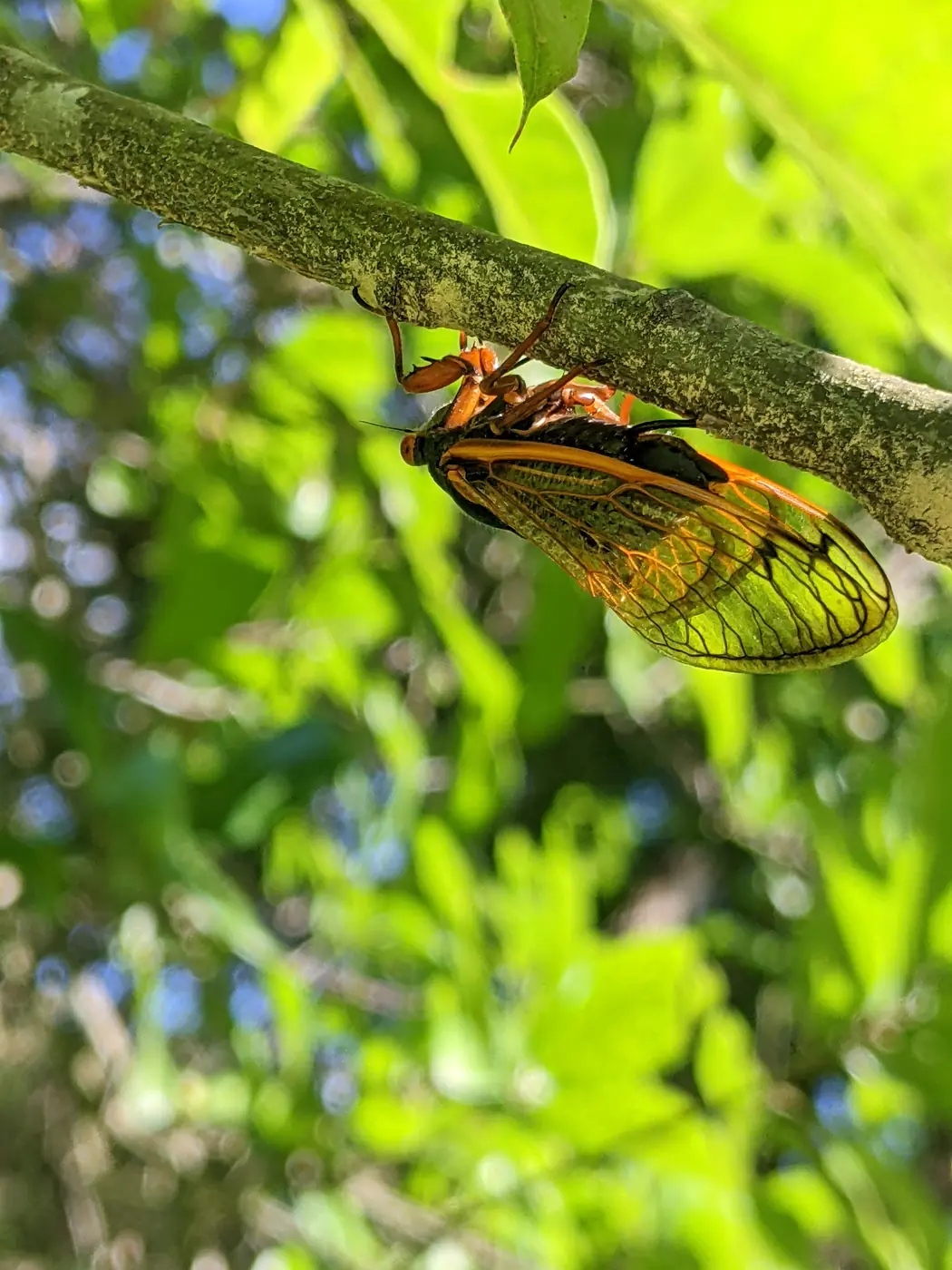 A periodical cicada laying eggs in Illinois in May 2024.
Credit: Jbjensen1 / Wikimedia Commons, CC BY 4.0.
A periodical cicada laying eggs in Illinois in May 2024.
Credit: Jbjensen1 / Wikimedia Commons, CC BY 4.0.

After hatching, the young drop to the ground and enter the soil, where root feeding supports their development.[5] Brood XIX is next scheduled to emerge in 2037 and Brood XIII in 2041.[4]
These responses occur over different periods. A bird can change its feeding immediately, while decomposers process the remains after adults die and plants may retain a growth advantage much later. Following the effects of the emergence in 2024 therefore involves tracing both the cicadas' bodies and changes in the feeding of other organisms. The end of the chorus was one stage in a longer movement through the food web.
Sources
- Cicadas
- Periodical cicadas disrupt trophic dynamics through community-level shifts in avian foraging
- Periodical cicadas as resource pulses in North American forests
- Broods
- Cicadas in Maryland
- Allochthonous subsidy of periodical cicadas affects the dynamics and stability of pond communities
- The effects of pulsed fertilization and chronic herbivory by periodical cicadas on tree growth
- Decomposition of periodical cicada carcasses influences nutrient uptake rates in experimental streams