Textile Waste: Why Are Blended Fabrics So Difficult to Recycle?
A shirt containing 60% cotton and 40% polyester combines materials with different chemical properties. These differences become a problem during recycling, since a treatment that removes one fibre can damage the other and make it…
A shirt containing 60% cotton and 40% polyester combines materials with different chemical properties. These differences become a problem during recycling, since a treatment that removes one fibre can damage the other and make it less useful for new textiles.[1]
Separating a blend is therefore only one part of recovering it. The materials produced also need to be suitable for something else. Research available through September 2025 demonstrates ways of making this separation, while showing why a working experiment does not immediately provide a recycling option for every discarded garment.
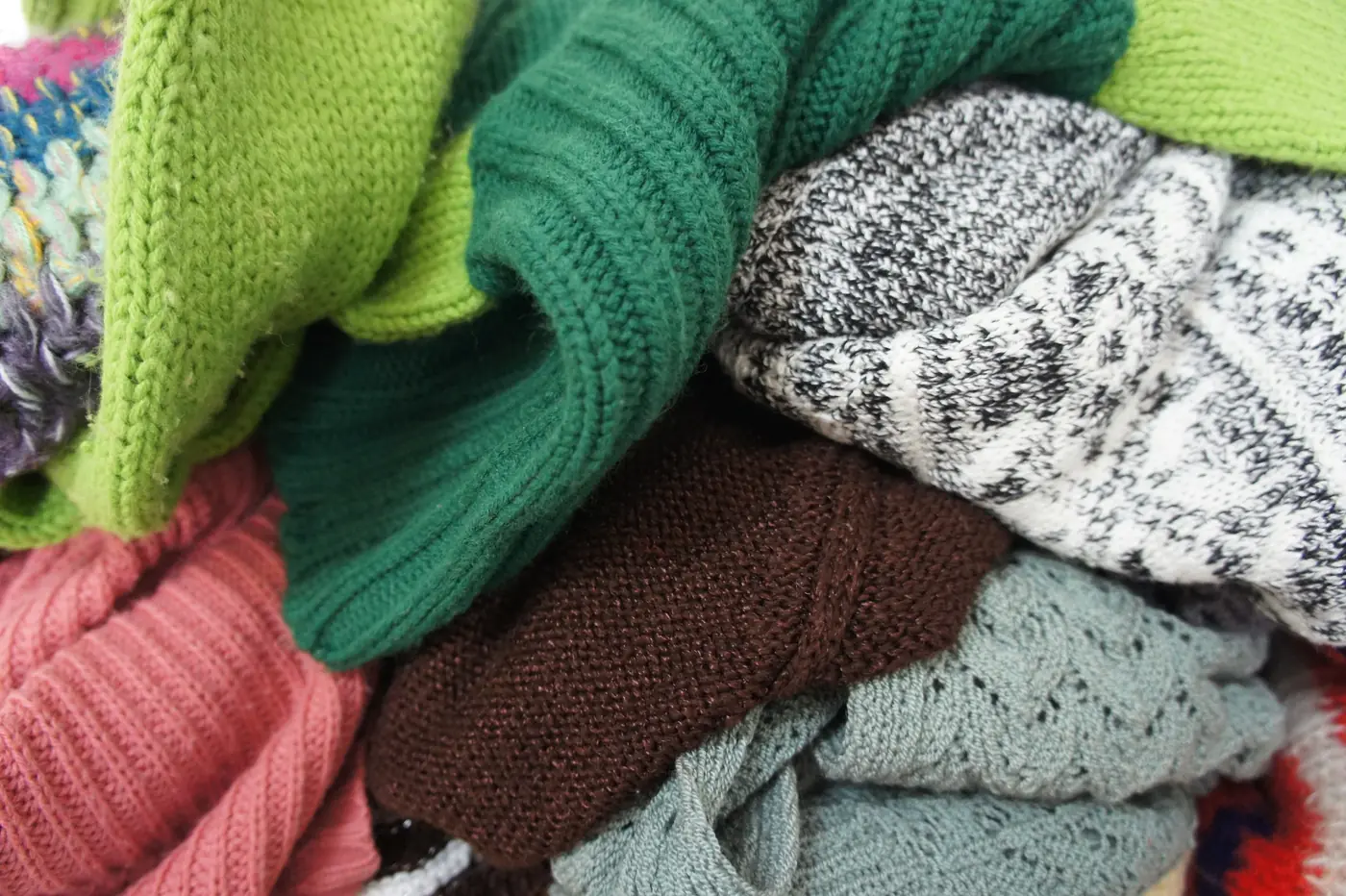 Discarded textiles photographed in 2014; an illustration of the materials entering reuse and recycling systems.
Credit: Ellen Sillekens / Wikimedia Commons / CC BY-SA 4.0.
Discarded textiles photographed in 2014; an illustration of the materials entering reuse and recycling systems.
Credit: Ellen Sillekens / Wikimedia Commons / CC BY-SA 4.0.

Textile Waste and the Recycling Gap
The amount of fibre being produced makes recovery an increasingly large task. Textile Exchange’s Materials Market Report 2025, released in September, estimates that global production reached approximately 132 million tonnes in 2024, compared with 125 million tonnes in 2023. This includes fibres for clothing, household textiles and other applications. It measures what was produced, rather than how much became waste.[2]
Waste figures show how much material already escapes recovery. The European Environment Agency estimated that the EU generated 6.95 million tonnes of textile waste in 2020, roughly 16 kilograms per person. Of that per-person total, 11.6 kilograms entered mixed household waste, while 4.4 kilograms were collected separately for reuse and recycling.[3] Separate collection gives textiles a chance of another use, but further sorting determines where they can actually go.
Recycled content does not always come from used textiles. Textile Exchange reports that less than 1% of global fibre production came from recycled textile waste in 2024, including both manufacturing waste and discarded consumer textiles. At the same time, 98% of recycled polyester came from plastic bottles.[2] A recycled-polyester label does not, on its own, tell us whether old clothes became new ones or whether the garment can be recycled again.
The Materials Inside a Blend
Cotton is mainly cellulose, a natural polymer made of long molecular chains. Polyester in clothing is usually polyethylene terephthalate, or PET, which is used in blends because of its strength and competitive cost. Since their molecular structures differ, a recycler can use a treatment that dissolves or breaks down one while leaving the other behind.[1]
The treatment needs to be controlled carefully. Cotton intended for new fibres must retain enough of its cellulose chain length, because breaking the chains down too far removes the structure needed for that use. It may still be possible to recover useful chemicals, but not the same textile material. Polyester spread throughout the fabric must also be accessible to whichever treatment is used to remove it.
A stretch fabric may also contain elastane, known as spandex, which adds another polymer to the mixture. Separating cotton and polyester does not resolve what happens to this extra material. Researchers have selectively broken down elastane and polyurethane coatings in particular textile combinations, demonstrating how the choice of process depends on the materials actually present.[4]
Zips, buttons, dyes and functional finishes can require their own removal or handling. A garment contains more than its main fibre, so a recycler needs enough information to account for these additions as well.[5]
The Limits of Shredding
Mechanical recycling opens up fabric to recover fibres, commonly through cutting and shredding. The treatment shortens and damages fibres, limiting how much recovered material can be incorporated into suitable new fabric. Material that cannot meet those quality requirements may find uses in insulation, wiping materials or other products.[5]
Shredding a blended fabric leaves mixed fibres unless another separation step is added. The mixture may be useful for some products but unsuitable for a process that requires a purified material. Its value depends on the quality recovered and whether a manufacturer can use it.
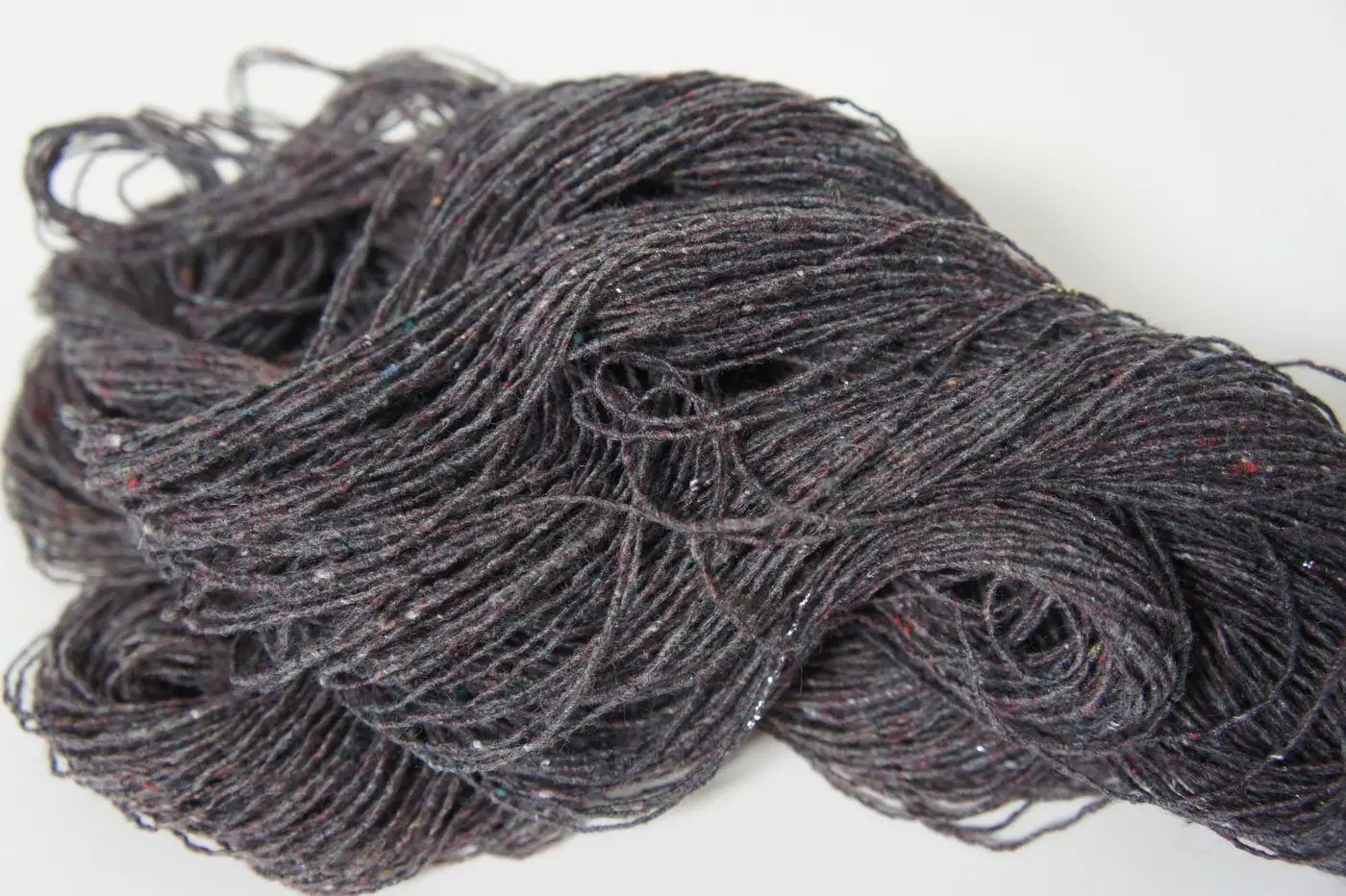 Yarn made from a blend of post-consumer textiles, photographed in 2014.
Credit: Ellen Sillekens / Wikimedia Commons / CC BY-SA 4.0.
Yarn made from a blend of post-consumer textiles, photographed in 2014.
Credit: Ellen Sillekens / Wikimedia Commons / CC BY-SA 4.0.

Other methods work on the polymers themselves. A solvent can dissolve one component, allowing the solid that remains to be separated, after which the dissolved polymer can be recovered and made into fibres if its quality is suitable. Depolymerisation breaks molecular chains into smaller building blocks that can be used in later manufacturing.[6] Because these methods recover different things, describing a fabric as recycled is incomplete without explaining the resulting material.
What the 2025 Research Demonstrates
One approach published in Nature Communications in January 2025 used highly concentrated hydrochloric acid to break the cotton in polycotton waste into glucose. Polyester remained as a solid residue, allowing it to be separated and subsequently converted into a chemical building block for polyester production.[7]
The researchers also tested the cotton-breakdown step in a 230-litre pilot reactor with 11.6 kilograms of used textiles, extending the work beyond a small laboratory sample. In this process, the cotton became sugar for further chemical processing. The study did not return both components directly to their original textile fibres.
A different route, reported in the September 2025 issue of Resources, Conservation and Recycling, aimed to preserve the cotton. Using an organic solvent and agents that partially broke down polyester, the researchers treated heavily coloured fabric containing equal proportions of cotton and polyester. Smaller polyester molecules, dyes and pigments stayed in the liquid, allowing clean cotton to be recovered.[8]
The recovered cotton was mixed with kraft pulp and spun into viscose, which is made by dissolving cellulose and forming fibres again. This returned material from a blended textile to textile fibres, but also required additional pulp. The paper described the separation approach as ‘waterless’; this does not mean that collection, recycling and the complete fibre-production process use no water.
These methods have different aims. One preserves cellulose for making fibres, while another turns it into chemical feedstock. The intended next use helps determine which process is suitable and what quality the recovered material needs to have.
The Work Beyond the Reactor
Before processing, recyclers need to know what is in the incoming textiles. Near-infrared spectroscopy measures how materials interact with light and can help identify fibre composition for sorting. Recognising a blend does not separate its fibres, however, and a recycler still needs a dependable supply of textiles that meet the process requirements.[5]
Recovering the materials also requires managing solvents, energy use and purification. These affect the cost and environmental performance, so the proportion recovered cannot be the only measure of success.[6] The output needs to reach a quality and price that makes it usable for a manufacturer, while accounting for the resources consumed in producing it.
These requirements connect the laboratory to the collection system. The EEA warns that expanding textile collection without sufficient sorting and recycling capacity can leave more collected material destined for incineration, landfill or export.[3] More collection bins therefore need to be matched by processing capacity and reliable destinations for the outputs.
Designing for Another Life
Some recycling difficulties can be addressed when a garment is designed. Materials can be chosen to match an available process, components can be made easier to remove, and composition information can be provided clearly. Durability and repairability also matter because a garment that remains useful for longer retains more of the value invested in making it.[9]
Repairing, wearing and reusing existing clothes can delay when they become waste. Replacing a usable blended garment with a simpler fabric still creates demand for another product, so fibre composition is more useful as a consideration for future purchases than as a reason to discard clothes that continue to work.
Manufacturers need to consider how a garment performs, how long it lasts and what can happen to its materials afterward. Choosing a blend with a known recovery route connects those decisions before the finished clothing reaches a collection bin.
Sources
- Hydrolytic-Assisted Fractionation of Textile Waste Containing Cotton and Polyester
- Materials Market Report 2025
- Management of used and waste textiles in Europe’s circular economy
- Selective chemical disassembly of elastane fibres and polyurethane coatings in textiles
- Facilitating a Circular Economy for Textiles Workshop Report
- Advancing Textile Waste Recycling: Challenges and Opportunities Across Polymer and Non-Polymer Fiber Types
- Polycotton waste textile recycling by sequential hydrolysis and glycolysis
- Enabling waterless polycotton textile waste recycling via controlled partial depolymerization of polyester
- Textiles and the environment: the role of design in Europe’s circular economy