Sinking Cities: The Hidden Cost of Groundwater Extraction
Cities use groundwater to supply homes, businesses and agriculture, but sustained extraction can also affect the ground beneath them. In vulnerable aquifers, pumping causes underground sediments to compact and the land surface to…
Cities use groundwater to supply homes, businesses and agriculture, but sustained extraction can also affect the ground beneath them. In vulnerable aquifers, pumping causes underground sediments to compact and the land surface to sink. Known as land subsidence, this can damage buildings and water networks while permanently reducing the space available to hold water underground.[1]
A well may continue delivering water while these changes take place below the surface. By the time they appear as repeated road damage or drainage problems, some of the changes underground may already be irreversible.
How Does Groundwater Extraction Make Cities Sink?
Groundwater in sedimentary aquifers fills small spaces between grains of sand, gravel and other material. The pressure of that water helps support the layers above it. As pumping lowers the pressure, more weight is transferred to the grains themselves, causing compressible layers to squeeze together and potentially lowering the ground above them.[2]
Aquifers containing clay and silt are especially vulnerable in some places. These fine-grained layers may lie within or between the more permeable layers supplying wells, and water drains from them slowly. As a result, their response can continue developing over a long period, with the surface reflecting changes across several underground layers.
Some compression is elastic: sediments can expand again as water pressure recovers. Beyond a threshold determined by their previous loading, however, fine-grained sediments can rearrange into a more tightly packed structure. Much of that lost pore space cannot be recovered simply by replenishing the water.[1][2]
Even if groundwater levels stabilise or recover, slow drainage and continuing deformation in clay layers can cause further sinking. Reducing excessive pumping may therefore take time to slow the movement, which makes acting before extensive compaction more useful than waiting for visible damage.[3]
A City's Geology Shapes the Damage
Much of Mexico City lies over a former lake basin, where thick clay deposits sit above groundwater resources. Long-term extraction has contributed to continuing compaction of these sediments. At one northeastern location, measurements recorded sinking of roughly 50 centimeters a year, although this was a local extreme rather than the rate across the city.[4]
Research comparing ground movement with the underlying geology found that the thickness of the upper clay layer helped explain where sinking was fastest. Nearby pumping locations and volumes could not explain the pattern on their own. Both the materials beneath the city and their history of pressure changes influence how the land responds to water being removed.
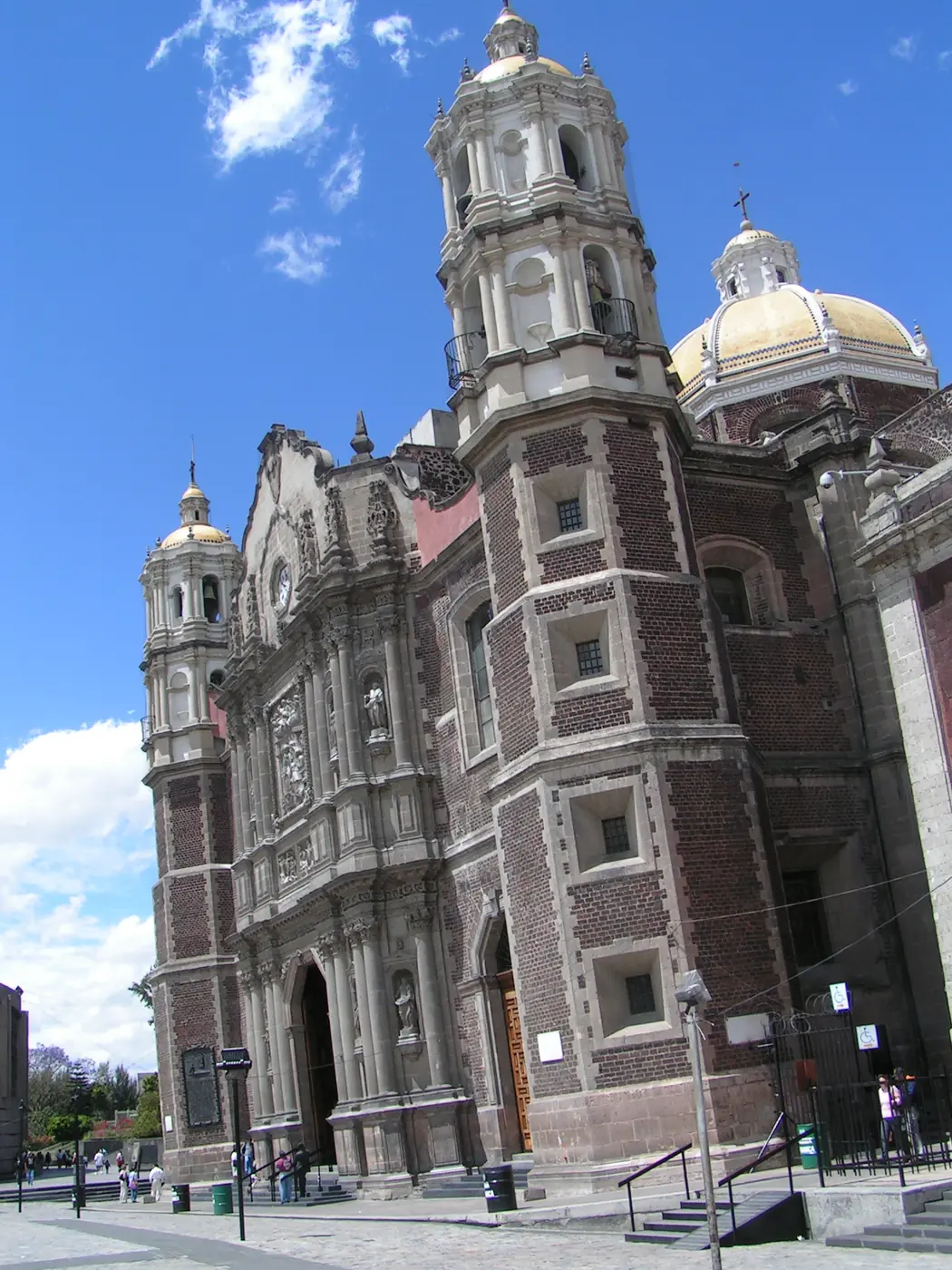 The old Basilica of Guadalupe is among Mexico City's historic buildings affected by subsidence.[1]
Credit: Jan Zatko / Wikimedia Commons, CC BY-SA 3.0.
.JPG)
Subsidence also occurs at much slower rates across a far wider range of cities. Satellite analysis of the 28 most populous US cities identified sinking land covering at least 20% of every city studied. Approximately 34 million people lived on the affected land in the study's population estimates. Houston had particularly extensive areas of rapid subsidence.[5]
Groundwater extraction is not responsible for all urban subsidence. Sediments can compact naturally, while tectonic movement and the Earth’s continuing adjustment to former ice sheets also move the land. Identifying the local causes is necessary because reducing pumping can only address the movement associated with groundwater use.
The Cost of Uneven Ground
A building can be especially vulnerable when the ground beneath one side sinks faster than the ground beneath the other. This uneven movement, called differential settlement, can crack walls, tilt foundations and strain connections to buried pipes. For the structure, the difference between its sides may matter more than the average sinking rate of the surrounding neighborhood.[5]
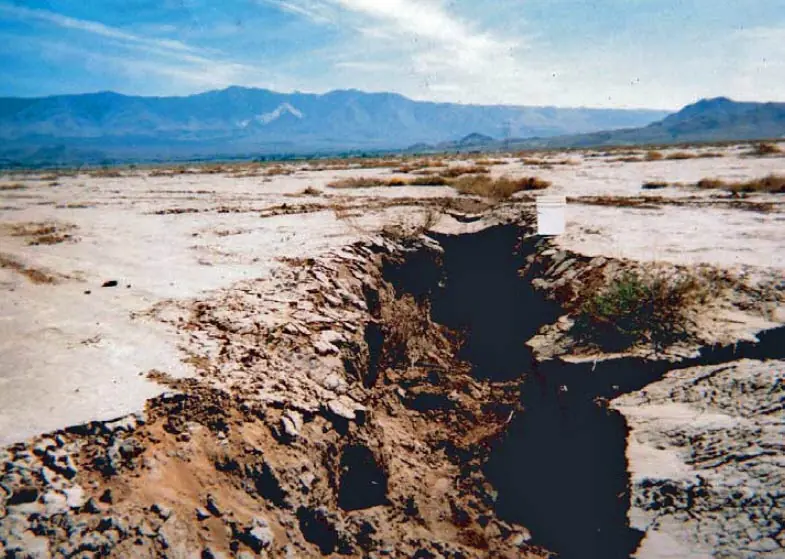 A fissure associated with groundwater withdrawal near Lucerne Lake in California's Mojave Desert illustrates how uneven compaction can deform the surface.
Credit: Loren Metzger / U.S. Geological Survey, public domain.
The resulting expenses appear in different places: homeowners pay for foundation repairs, utilities maintain damaged networks, and public agencies improve drainage or flood defenses. Because these costs are divided among different groups, they are not always recognised together as consequences of groundwater extraction.[3] Water that seems inexpensive at the well can become costly for the wider city.
Flooding Above, Water Insecurity Below
Coastal communities face an additional problem because sinking leaves the land lower relative to the sea. If the ocean is also rising, both changes increase the water level experienced at the shoreline. Flood exposure can worsen even when an individual storm is no stronger than before.[3]
Jakarta illustrates how that loss of elevation interacts with everyday drainage. Groundwater extraction, construction loads and natural consolidation of sediments all contribute to its subsidence. Documented consequences include altered canal and drain flows, malfunctioning drainage systems and an expansion of areas affected by coastal and river flooding.[6]
As land sinks unevenly, the slopes that allow rainwater to drain away can become less effective. Cities may need more pumping or changes to their drainage systems to keep neighborhoods dry. Flood barriers can help, but their design also needs to consider further settlement of the land beneath and around them.
Meanwhile, the wells supplying the city face another pressure. Falling groundwater levels can force operators to deepen wells or lift water farther, increasing energy costs. In coastal aquifers, pumping can also draw saline water toward freshwater supplies, reducing the usefulness of the water that remains.[7]
Compaction can permanently remove some of the pore space that stores water in the aquifer system.[1] This leaves a city with less underground storage at the same time that managing water and flooding above ground is becoming more difficult.
Slowing the Sinking
People and businesses can more readily reduce groundwater use when they have a reliable alternative supply. In Tokyo, controls on extraction were introduced alongside the development of other water sources, eventually stopping severe pumping-related subsidence.[8] Restrictions and replacement supplies need to work together if users are to change where they obtain their water.
Managed recharge can help restore groundwater levels by directing water underground through infiltration basins or injection wells.[9] Whether it works depends on local conditions and an appropriate water supply, and returning water does not necessarily restore pore space lost to permanent compaction.[1] Planning for water availability also requires protecting the ground that stores it.
Monitoring makes it possible to judge whether those measures are working. Satellite observations can map ground movement across neighborhoods, while groundwater measurements and instruments tracking underground compaction help explain its causes. Used together, they guide decisions about where extraction needs to fall and where infrastructure requires protection.[8]
Where earlier compaction continues, stronger foundations, modified drainage and flood defenses may still be needed.[3] Reducing further sinking can limit these demands and help protect the groundwater supply that supports the city.
Sources
- Land Subsidence
- Mechanics of Pumping-Induced Land Subsidence
- Sinking coastal cities
- Over a Century of Sinking in Mexico City: No Hope for Significant Elevation and Storage Capacity Recovery
- Land subsidence risk to infrastructure in US metropolises
- Study on the risk and impacts of land subsidence in Jakarta
- Groundwater Decline and Depletion
- The 6M approach to land subsidence
- Artificial Groundwater Recharge