Pollinator Decline and the Hidden Threat to Our Food Supply
Apples, blueberries and squash depend, to different degrees, on animals visiting their flowers. Their dependence on pollination means that the health of insect populations, along with the places where they feed and reproduce, can…
Apples, blueberries and squash depend, to different degrees, on animals visiting their flowers. Their dependence on pollination means that the health of insect populations, along with the places where they feed and reproduce, can affect how reliably food is produced. When pollinators decline, harvests can become less dependable.[1]
These consequences are not always immediately visible. For instance, a crop can still produce food while falling short of its potential, and a supermarket can still stock fruit while some households struggle to afford it. To understand the effects of pollinator decline, we need to follow this connection from the flowers on a crop to the food farmers harvest and the variety people can afford to eat.
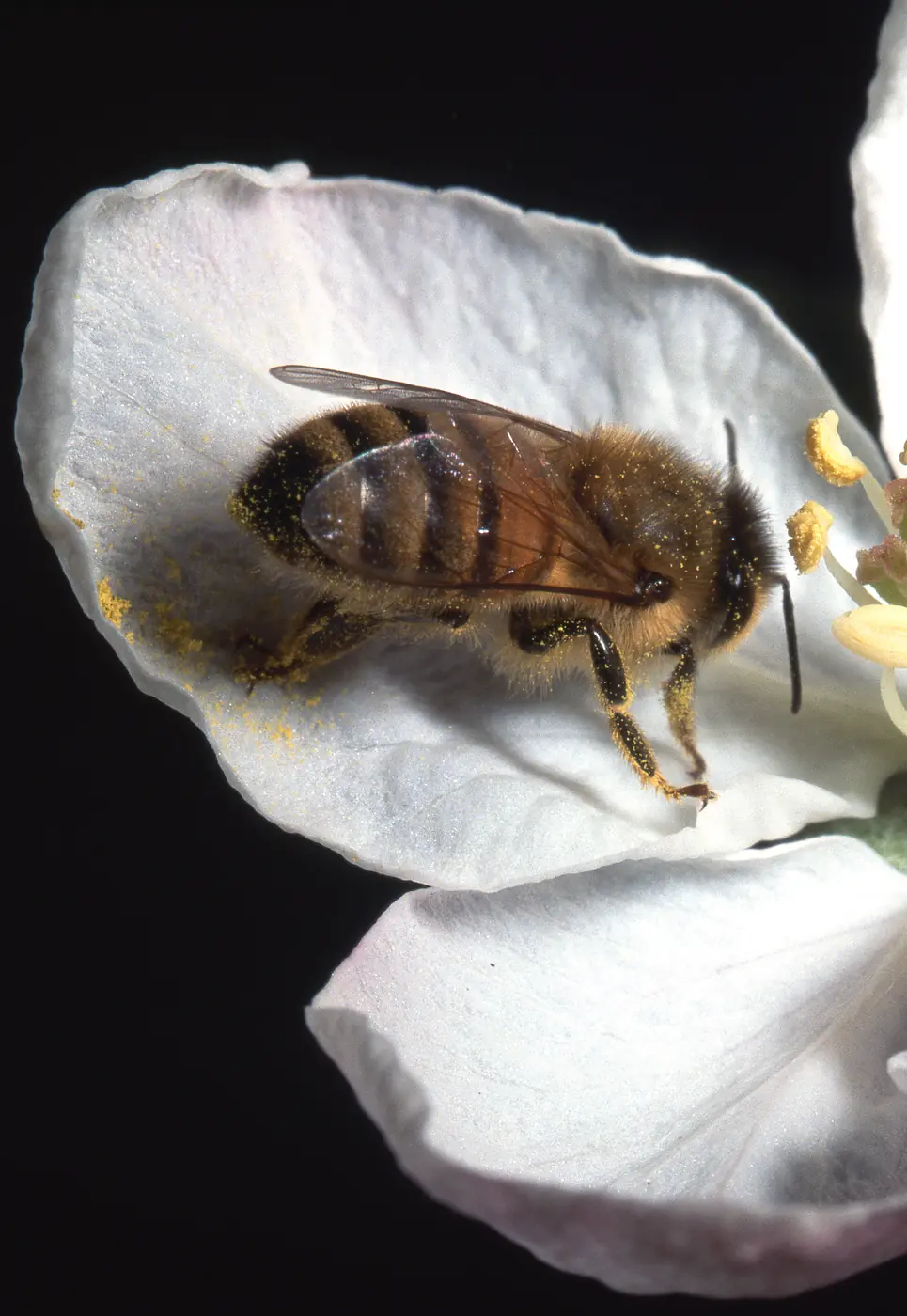 Credit: Jack Dykinga / USDA Agricultural Research Service.
Pollination and Our Food Supply
Pollination is the transfer of pollen to a flower's receptive surface, called the stigma, which makes fertilization and seed production possible. When a bee moves between flowers to gather food, pollen caught on its body can brush onto the next flower. This allows the plant to reproduce while the insect gathers food.[2] For crops grown for their fruit or seeds, the exchange also helps determine how much a farmer can harvest.
More than three-quarters of the world's leading food crop types benefit at least partly from animal pollination. However, this figure refers to the variety of crops, rather than their weight or contribution to our calories. According to the IPBES assessment, crops that benefit from animal pollination account for about 35% of global crop production by volume. Since these crops depend on pollinators to different degrees, this percentage does not tell us how much food would disappear without them. Major cereals, including wheat, rice and maize, do not require animal pollination.[1]
Honey bees kept in hives are only part of the pollination process. Across 41 crop systems, visits from wild insects were positively associated with the proportion of flowers that developed into fruit, even where honey bees were present. This means that both groups contributed to pollination, complementing each other.[3] Although managed honey bees can help farmers meet a crop's needs, we still need to protect the wild insects visiting those flowers because their contribution is not replaced by keeping hives.
The Meaning of Pollinator Decline
A community of pollinators can change in several ways: fewer insects may remain, individual species may disappear from places they once occupied, or the mix of species may become less varied. These changes are related, but measuring one does not automatically reveal the others.
Records from Britain show how differently species can respond within the same region. Of 353 wild bee and hoverfly species studied between 1980 and 2013, roughly one-third experienced shrinking distributions, while about one-tenth expanded. Some common species important for crop pollination increased, even as the broader community lost ground.[4] So although substantial losses occurred, it would be inaccurate to assume that every species declined everywhere. Understanding pollinator decline requires looking at which species are affected and where those changes are happening.
Seeing many insects on a patch of flowers may seem reassuring, but those insects could belong to a few successful species while others in the landscape have become scarce. Monitoring therefore needs to track both the number and identity of pollinators over time, along with the resources they need to survive. Addressing these gaps in what we know is a central priority of the U.S. Geological Survey's pollinator science strategy.[5]
Knowing how pollinators are changing across a region is useful, but a farmer also needs to know whether enough effective pollinators are reaching the crop while it flowers. Answering that question requires observations in the field.
The Pressures on Pollinators
When varied vegetation is replaced with extensive, simplified farmland, insects can lose both flowers to feed on and places to nest, affecting which pollinators can reach a nearby crop. Even a crop covered in blossoms provides food for only part of the year; insects still need resources before and after that flowering period. For this reason, protecting their habitat requires considering the pollinator's life cycle along with the crop's growing season.[5]
Pesticides put further pressure on these insects. In a synthesis of 681 crop fields across three continents, greater pesticide hazards and less surrounding semi-natural habitat were each associated with lower wild bee abundance and fewer species. Having more habitat did not consistently protect bees from the effects associated with pesticides.[6] Since extra habitat cannot be assumed to offset those effects, planting flowers needs to be accompanied by protection from harmful pesticide exposure.
Climate change can alter which species survive those conditions. A study combining 16 years of bee observations in the southwestern United States with laboratory experiments found that bees better able to tolerate heat and drying increased most over time.[7] Even if some bees remain abundant as conditions grow warmer, the composition of the pollinator community can still change. A landscape dominated by bees that tolerate drought best may therefore support different relationships between plants and pollinators than the community it replaces.
Disease, parasites and invasive species add further stresses, with effects that depend on the pollinator and location.[5] A response designed to address one problem in managed honey bees will not necessarily address the threats facing wild bees, flies and other flower visitors. Deciding how to help starts with understanding what is limiting their survival in that particular place.
The Consequences for Harvests
A field can have adequate growing conditions and still produce less fruit or seed if its flowers receive too few effective visits from pollinators. This is called pollinator limitation, meaning that insufficient pollination restricts the crop's yield. Determining whether it is happening involves looking at both the insects visiting the flowers and the harvest they help produce.
An analysis of 32 crop species across 120 study systems estimated that 28–61% of the systems were pollinator limited, depending on the analytical approach. Blueberries, coffee and apples were among the crops in which limitation appeared most frequently.[8] This range tells us how often a shortfall was detected in the systems represented in the research; it does not mean that 28–61% of the world's food has been lost.
There is still debate about how large that shortfall is. A subsequent scientific critique points out that fields with more flowers or more vigorous plants can attract more insects and produce more food, making it difficult to separate the effects of pollination from the plants' growing conditions. If studies do not account for those differences, they can overestimate how strongly too few pollinator visits restrict yield.[9] Adding pollen to flowers in experiments helps test whether extra pollination actually increases production.
Even a confirmed pollination shortfall does not establish a historical decline in insect numbers; that requires observations through time. For farmers, the immediate question is whether improving pollination could increase their harvest alongside adequate water, nutrients and pest management.
The Cost to Diets and Farming Incomes
The amount of food produced also does not tell us everything about its importance to people's diets. Fruits, vegetables and nuts contribute to healthy diets, so a smaller supply can affect food quality and access even where staple calories remain available. An economic and health modeling study estimated that inadequate pollination leaves global fruit, vegetable and nut production about 3–5% below what it could otherwise achieve.[10]
The estimate combines evidence about crop yield gaps with models of trade, consumption and health. Because it is based on modeling, it should not be read as a direct count of missing produce or proof that pollinator decline caused a particular price rise. It does, however, trace how a smaller harvest could affect people's diets: less food is available, changes in supply affect affordability, and affordability influences what people eat. The modeled effects varied across countries because production, purchasing power and existing diets differ.
In smallholder communities in Nepal, researchers examined this connection by linking crop pollination with yields, farming income and individual diets. They attributed 44% of farming income and more than 20% of vitamin A, folate and vitamin E intake in the communities studied to insect pollinators.[11]
These figures describe how much pollination contributes to the households studied, rather than losses they have already suffered, and they cannot be applied to all households in Nepal. Within these communities, families depend on pollinated crops for both the food they eat and the income they earn from farming. If a harvest weakens, both can be affected, making it harder for families to meet their needs.
The Conditions for Recovery
To protect these benefits, agricultural landscapes need to support pollinators throughout their lives. Flowering field margins, hedgerows and other habitat can provide resources before and after a crop's brief bloom, although how useful they are depends on what is planted, where it grows and how it is maintained.
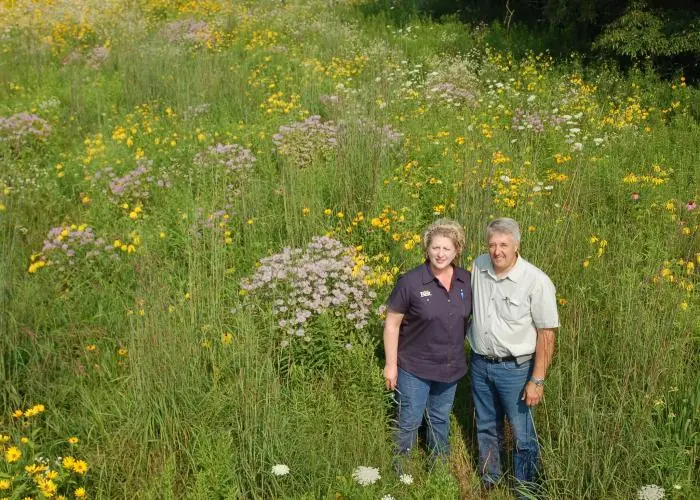 Pollinator habitat on Becky and Paul Rogers' property in Michigan illustrates how landowners can provide space for flowering plants.
Credit: USDA Natural Resources Conservation Service.
Pollinator habitat on Becky and Paul Rogers' property in Michigan illustrates how landowners can provide space for flowering plants.
Credit: USDA Natural Resources Conservation Service.
Studies of flower strips and hedgerows found that older, perennial flower strips with more diverse flowering plants tended to improve nearby crop pollination more effectively. These benefits diminished with distance, and effects on crop yield varied, so planting a strip does not guarantee a larger harvest.[12] The habitat needs to be close enough to the crop and have time to develop. Whether it improves pollination still has to be checked.
Reducing pesticide risk needs to be part of this work too. The findings from the 681-field synthesis support addressing habitat and pesticide pressures together.[6] This requires looking at the conditions insects experience across the farm, including where they feed and nest, to judge whether the changes are helping.
Gardens and public green spaces can contribute using the same basic principles. Choose locally native flowering plants with different bloom times, retain suitable nesting areas such as small patches of bare soil and sheltered vegetation, and avoid unnecessary pesticide use. The U.S. Fish & Wildlife Service recommends providing both food and nesting habitat because flowers alone do not meet every stage of a pollinator's life.[13]
By observing which insects visit a crop, whether there are enough effective visits and how the harvest responds to improved pollination, farmers can better understand how these measures affect food production. Habitat protection can then become part of how the farm produces food, because the flowers around a field support the insects visiting the crops within it.
Sources
- The assessment report on pollinators, pollination and food production
- What Is Pollination and Who Does It?
- Wild Pollinators Enhance Fruit Set of Crops Regardless of Honey Bee Abundance
- Widespread losses of pollinating insects in Britain
- U.S. Geological Survey Pollinator Science Strategy, 2025–35—A Review and Look Forward
- Pesticides and habitat loss additively reduce wild bees in crop fields
- Heat and desiccation tolerances predict bee abundance under climate change
- Insufficient pollinator visitation often limits yield in crop systems worldwide
- Are crop yields limited by pollinators? Proper assessments using pollinator gradients require measurements of flower density and yield potential
- Pollinator Deficits, Food Consumption, and Consequences for Human Health: A Modeling Study
- Pollinators support the nutrition and income of vulnerable communities
- The effectiveness of flower strips and hedgerows on pest control, pollination services and crop yield: a quantitative synthesis
- Attracting Pollinators to Your Garden