Natural Hydrogen and the Search for Energy Beneath the Earth
When a borehole was drilled for water near Bourakebougou, Mali, in 1987, it encountered something that would eventually draw attention far beyond the village: naturally occurring hydrogen. Years later, analysis showed that gas from…
When a borehole was drilled for water near Bourakebougou, Mali, in 1987, it encountered something that would eventually draw attention far beyond the village: naturally occurring hydrogen. Years later, analysis showed that gas from the shallow reservoir contained about 98% hydrogen. A pilot project began using it to generate electricity in 2012, demonstrating that an underground hydrogen accumulation could provide usable energy.[1]
The project raises the possibility that similar accumulations elsewhere could supply hydrogen with fewer emissions. Before that possibility can become a dependable source of energy, exploration has to establish how much gas a deposit contains, how quickly it can be extracted and how long it will last.
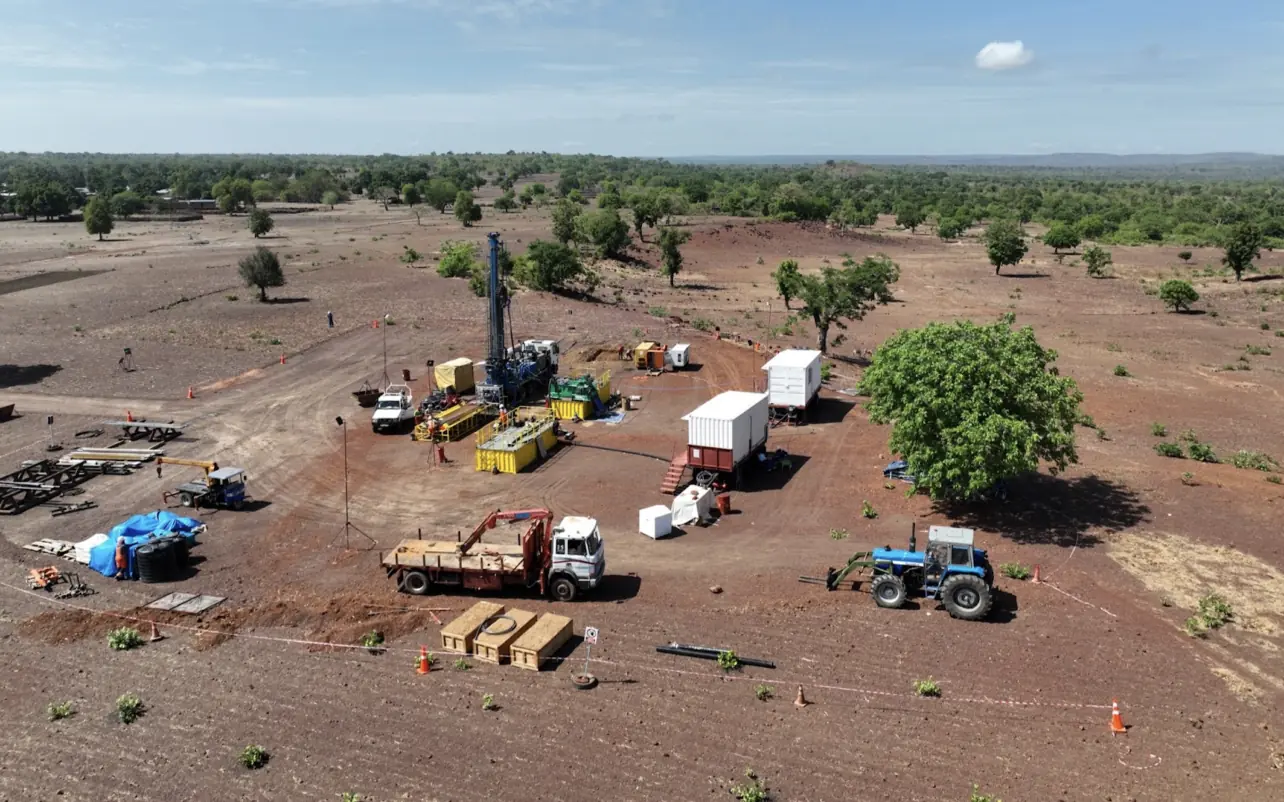 A drilling site from Hydroma's natural hydrogen exploration campaigns in Mali.
Credit: Hydroma.
A drilling site from Hydroma's natural hydrogen exploration campaigns in Mali.
Credit: Hydroma.
What Is Natural Hydrogen?
Natural hydrogen is molecular hydrogen, or H₂, produced through natural processes within the Earth. It is sometimes called geological, white or gold hydrogen, but these terms describe where it comes from. The molecule is the same as hydrogen manufactured in an electrolyser or used in industry.[2]
Most hydrogen used today has to be manufactured, with fossil fuels dominating production. Electrolysis offers another route by using electricity to split water into hydrogen and oxygen. If geological processes have already produced the gas underground, extracting it could avoid much of the energy use and emissions required to manufacture it.[2]
There is already a substantial market for a cleaner supply. Global hydrogen demand approached 100 million tonnes in 2024, largely for established uses such as refining and chemical production. Yet hydrogen made through processes classified as low emissions accounted for less than 1% of global production, according to the International Energy Agency.[3] Natural hydrogen therefore has a possible role even before more ambitious uses of hydrogen become widespread.
Hydrogen From Water and Rock
One important route to hydrogen begins when water encounters minerals containing iron. Under suitable conditions, the iron becomes oxidised and hydrogen is released from the water. This can happen during serpentinization, a process in which water alters rocks containing minerals such as olivine, forming new minerals that include serpentine.[4]
For the reaction to occur, water has to reach suitable rock, often through fractures. Temperature and mineral composition also influence what happens. A large amount of reactive rock can therefore indicate potential without guaranteeing a large hydrogen supply, since the conditions have to allow the reaction to proceed.[5]
Hydrogen can also form through radiolysis. Radiation from the natural decay of elements such as uranium, thorium and potassium breaks apart water molecules, setting off reactions that can produce H₂. This provides another route to hydrogen generation in the crust, including in ancient rocks where water has remained underground for long periods.[5]
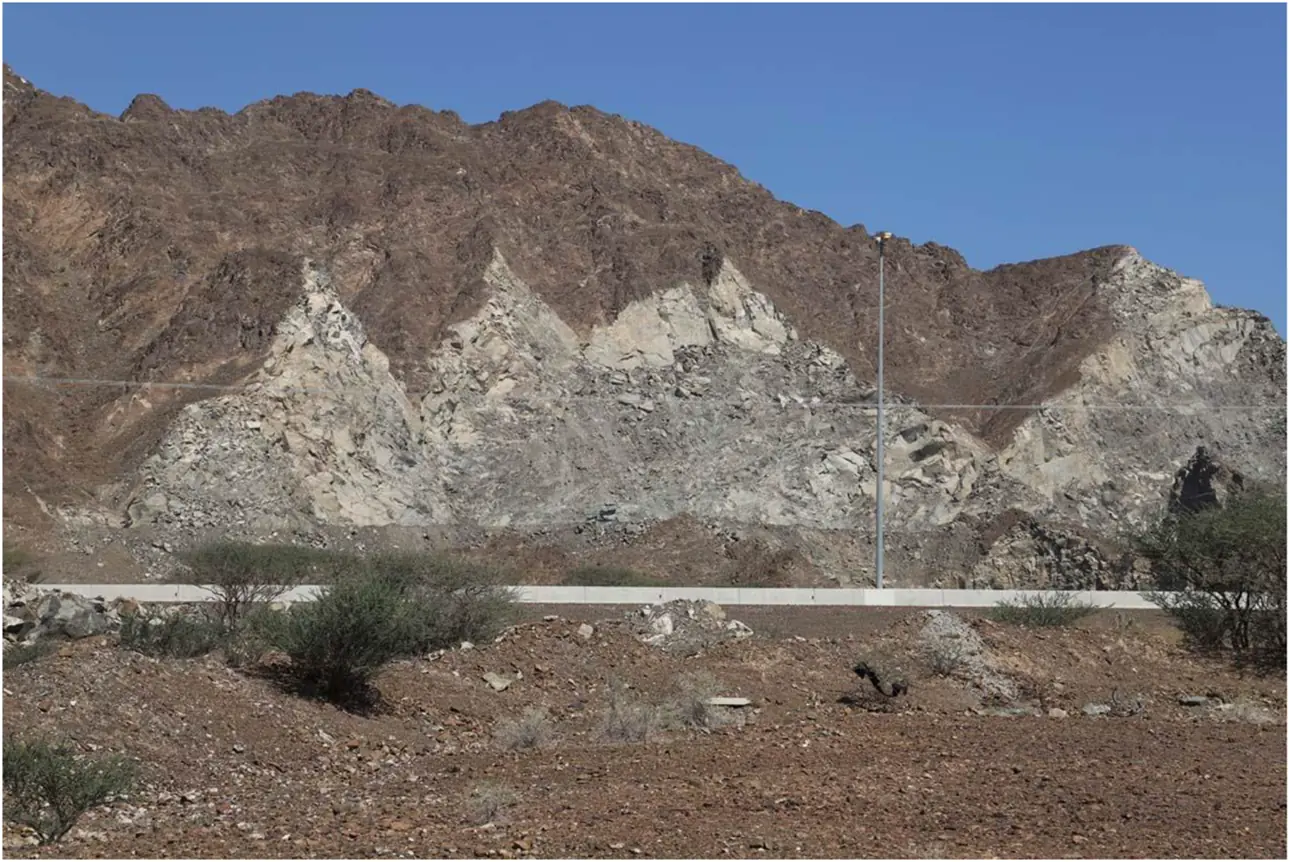 Serpentinized peridotite exposed along the Hatta Road in the United Arab Emirates. The photograph shows rock altered by water, rather than a confirmed hydrogen deposit.
Credit: Howari et al. / Frontiers in Earth Science, Figure 4, CC BY.
Serpentinized peridotite exposed along the Hatta Road in the United Arab Emirates. The photograph shows rock altered by water, rather than a confirmed hydrogen deposit.
Credit: Howari et al. / Frontiers in Earth Science, Figure 4, CC BY.
The Search for Underground Reservoirs
Hydrogen does not necessarily accumulate after it forms. Microbes can consume it and chemical reactions can remove it as it travels underground. The remaining gas needs connected pores or fractures through which to move, space in a reservoir rock and a seal that limits its escape.[4]
Exploration therefore involves finding a geological system in which the source, movement pathways and trapping conditions work together. Hydrogen detected at the surface can suggest a source below, but escaping gas does not reveal whether a useful accumulation remains underground.[4]
At Bourakebougou, the shallow reservoir provides a concrete example. Hydrogen occupies cavities in carbonate rock beneath layers of dolerite that act as seals. Further drilling identified hydrogen in additional wells and at several depths, allowing scientists to examine how the gas is distributed through the rock.[1]
The US Geological Survey has mapped hydrogen prospectivity across the contiguous United States to identify regions with conditions that could favour accumulation. Such observations help guide exploration by narrowing the search. A mapped area, however, is not a confirmed recoverable deposit.[6]
Drilling and testing are needed to determine what a location can supply. Even a sample with a high hydrogen concentration does not establish that a well will deliver enough gas. The flow must also be sufficient and sustained over time for an energy project to use it.[7]
From Geological Potential to Usable Supply
The possible scale of the resource explains much of the interest. A global model developed by USGS scientists estimated a most probable underground hydrogen inventory of roughly 5.6 trillion metric tonnes. Its results spanned an exceptionally wide range, reflecting major uncertainties about how much hydrogen is generated, consumed, retained and lost.[8]
The estimate concerns hydrogen potentially present within the Earth, rather than discovered fields or gas available for sale. Much of it may be too deep, too far offshore or spread among accumulations too small to recover economically. Even how much could be reached technically remains uncertain.[8]
A well illustrates why both flow rate and purity matter. A small pocket can produce a hydrogen-rich sample, whereas a larger flow might contain too little hydrogen to process economically. Production also has to continue for years. An analysis of published observations found that available flow measurements generally fell below the requirements of modelled commercial projects.[7]
A discovery announcement therefore begins an assessment rather than completing it. Reliable production has to be demonstrated before an underground prospect can be considered a credible source of supply.
The Question of Renewal
Because geological processes continue producing hydrogen, the resource is sometimes described as renewable. However, continued production does not necessarily mean a reservoir refills as fast as gas is extracted. Researchers at Bourakebougou interpreted the reservoir's behaviour as evidence of recharge during production.[1]
That recharge could involve gas arriving from another part of the subsurface, without new hydrogen being generated at the extraction rate. A review of continental hydrogen systems concluded that natural generation generally does not allow renewal over decades to centuries.[5]
Gas accumulated over geological time could still be useful, but extracting it would reduce a finite supply. To claim that a field is continuously replenished, producers would need evidence that generation keeps pace with extraction at a useful scale. The published flow analysis casts doubt on that possibility for the natural systems assessed.[7]
The Climate Test
Extracting hydrogen already present underground could reduce the need for emissions-intensive manufacturing, although wells still require materials and energy. Recovered gas may also need separation, treatment and compression before use. The climate benefit therefore depends on the whole production process.[9]
A prospective life-cycle assessment found that natural hydrogen could have low greenhouse gas emissions under favourable conditions. Its results depended on factors including gas composition, the handling of waste gases and the energy used for processing. Associated methane is especially relevant: allowing it to escape would add warming even if the main product were hydrogen.[9]
Leaks of hydrogen also affect the climate, even though the gas does not directly trap heat in the same way as carbon dioxide. Hydrogen can reduce the availability of hydroxyl radicals that remove methane and thereby extend methane's lifetime. It can also affect ozone and water vapour in ways that increase warming. Preventing leaks protects the product as well as its potential climate benefit.[10]
For an industrial customer, a discovery becomes useful when it provides a dependable supply at a competitive delivered cost and with verifiably low emissions. Interest in natural hydrogen gives researchers a reason to look more closely underground, but wells will have to demonstrate how much usable gas they provide, for how long and with what environmental footprint.
Sources
- Characterization of the spontaneously recharging natural hydrogen reservoirs of Bourakebougou in Mali
- Geologic Hydrogen
- Global Hydrogen Review 2025
- The Potential for Geologic Hydrogen for Next-Generation Energy
- Natural hydrogen resource accumulation in the continental crust
- Prospectivity mapping for geologic hydrogen
- The relationship between natural hydrogen flow rates and production viability
- Model predictions of global geologic hydrogen resources
- Greenhouse gas intensity of natural hydrogen produced from subsurface geologic accumulations
- A multi-model assessment of the Global Warming Potential of hydrogen