Land Degradation and the Slow Loss of Productive Soil
Continued crop production does not always mean that soil remains healthy. Fertilizer and other inputs can maintain harvests while the land becomes less able to support plant growth on its own. This can make degradation difficult to…
Continued crop production does not always mean that soil remains healthy. Fertilizer and other inputs can maintain harvests while the land becomes less able to support plant growth on its own. This can make degradation difficult to recognise from the crop alone, even as the soil beneath it deteriorates.[1]
According to a new assessment from the Food and Agriculture Organization of the United Nations (FAO), around 1.7 billion people live in areas where human-induced land degradation is reducing crop yields.[2] The consequences begin with changes in the soil processes that allow crops to grow.
What Is Land Degradation?
Land degradation is a lasting loss of the land’s ability to perform functions such as supporting ecosystems and growing vegetation. It affects forests and grazing land as well as cultivated fields. On farms, erosion, unsustainable cultivation and poorly managed irrigation can damage the soil and contribute to this decline.[2]
Soil supplies roots with air, water and nutrients through the activity of living organisms and the spaces between its particles. Bacteria and fungi help cycle nutrients, while roots and soil organisms maintain pathways for air and water. Together, these processes allow rain to enter, some moisture to remain for dry periods and plants to keep growing.[3]
Organic matter, including decomposing plant material, supports soil organisms and helps maintain a stable structure. The spaces within that structure allow water to enter and roots to spread. If management depletes organic matter and weakens the structure, more rain can run off rather than soaking in, leaving less stored moisture for crops between showers.[4]
How Productive Soil Is Lost
When rain hits bare ground, it can break soil clumps apart. The loosened particles may then block pores at the surface, reducing the amount of water that enters. More water flows over the ground and can carry soil away with it. Removing vegetation and repeatedly disturbing soil makes it more exposed to this process.[5]
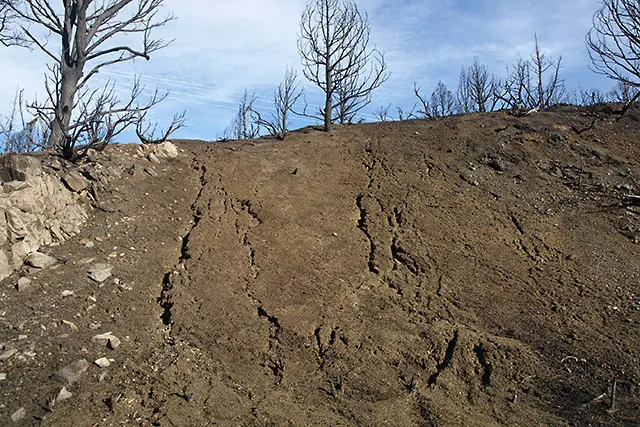 An example of rangeland erosion, illustrating how water cuts into exposed ground.
Credit: Mark Weltz / USDA Agricultural Research Service
An example of rangeland erosion, illustrating how water cuts into exposed ground.
Credit: Mark Weltz / USDA Agricultural Research Service
The loss of structure can make further damage more likely. As less rain enters the soil, more runs off and less remains available to plants. A field can experience water stress even when it receives rain because it cannot retain enough of that water. Protecting the surface helps more rainfall reach the root zone.[5]
Soil does not have to be carried away to lose function. Heavy machinery can compress it, particularly when the ground is wet, squeezing out pore space and forming compacted layers. Roots then struggle to penetrate the soil and water moves through it less easily, restricting the crop’s access to moisture and oxygen.[6]
Irrigation can cause another problem when salts accumulate. The water usually contains dissolved salts, which remain as plants take up water and some evaporates. Without enough leaching and drainage, these salts build up around roots and make water harder to absorb. Crops can then experience water stress despite moisture still being present in the soil.[7]
Soil Under Climate Pressure
These vulnerabilities become more consequential when weather puts the land under strain. Prolonged drought can reduce vegetation cover, exposing soil to erosion. More intense rainfall can increase the force of water moving across an already vulnerable surface. The Intergovernmental Panel on Climate Change identifies climate change as an aggravating factor in several land degradation processes, while emphasizing that land management strongly influences the outcome.[8]
Damaged soil also gives crops fewer ways to cope with difficult weather. Poor infiltration and restricted roots can limit the moisture available during a dry period. Improving soil structure and retaining organic matter can increase that capacity, although the effects depend on the soil, climate and practices used.[4][6]
Protecting soil is therefore part of adapting agriculture to climate change, since it improves the condition of the land experiencing these pressures. The response needs to fit the location because both the causes of degradation and the available ways to reduce it vary across landscapes.[8]
The Hidden Cost of a Harvest
In wealthier agricultural systems, intensive use of fertilizer and other inputs can compensate for some soil damage and conceal its effects on production, as FAO’s assessment describes. The field may continue producing crops while becoming more dependent on inputs to make up for deteriorating land.[1]
The report's estimates should also be read carefully. Its analysis compares soil carbon, erosion and water conditions with a modelled baseline without human disturbance. The resulting losses describe the effects of accumulated degradation, rather than a single year's change in harvests.[2]
Farmers with limited access to inputs, credit or markets face different constraints. When degradation occurs alongside these difficulties, improving harvests or investing in the soil becomes harder. Recovery depends partly on whether the people managing the land have the resources to make changes.[1]
Keeping Soil Productive
Protective practices can help restore the connections between soil, plants and water. Crop residues left on the surface absorb some of the impact of rain and protect against wind. Cover crops maintain living roots between main crops, supporting soil organisms and improving infiltration. Diverse rotations and less disturbance can work alongside these practices.[3]
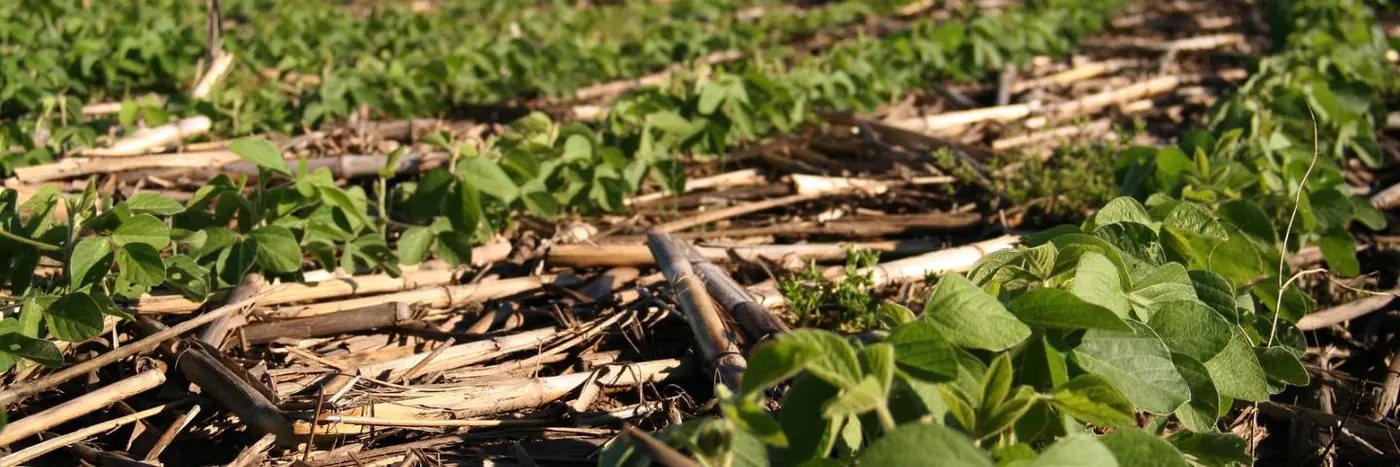 Soybeans grow through residues from the previous corn crop in Monticello, Illinois.
Credit: Paige Buck / USDA NRCS Illinois
Soybeans grow through residues from the previous corn crop in Monticello, Illinois.
Credit: Paige Buck / USDA NRCS Illinois
The practices need to address the conditions in each field. Cover crops must suit the climate and cropping system.[3] If salts are accumulating, irrigation water quality and drainage need attention, since adding water without controlling drainage may leave the problem unresolved.[7] Where soil is compacted, keeping heavy traffic off wet ground can prevent further damage.[6]
Putting these changes into practice also takes support. FAO calls for policies tailored to different farm sizes and conditions, including incentives for sustainable management and measures to discourage damaging land-use practices.[2] Secure land rights matter because farmers are more likely to invest in improvements when they expect to benefit from the land in the future.[1]
The condition of the soil after a harvest helps determine what the next growing season can produce. Roots need space to grow, rainfall needs a way into the ground, and soil organisms need organic matter. Assessing these functions alongside the crop gives a fuller picture of how much productive capacity the field retains.
Sources
- The State of Food and Agriculture 2025 – Addressing land degradation across landholding scales
- FAO report: 1.7 billion people experience lower crop yields due to land degradation
- Principles for High Functioning Soils
- Role of Organic Matter
- Drought-resistant soils
- National Agronomy Manual
- CHAPTER 7 - SALTY SOILS
- Chapter 4 : Land Degradation