Cement’s Carbon Footprint and the Search for Cleaner Construction
Producing the materials for a building releases greenhouse gases before anyone begins using it. Cement accounts for a substantial share of this footprint: an October 2024 account from UCLA put its production at about 8% of global…
Producing the materials for a building releases greenhouse gases before anyone begins using it. Cement accounts for a substantial share of this footprint: an October 2024 account from UCLA put its production at about 8% of global carbon dioxide emissions.[1]
Reducing those emissions is difficult because they come from both the energy used in manufacturing and the chemistry of the raw material. Changes are possible in how cement is made, how much is used in concrete and how much new concrete a structure requires. Research and announcements published that October showed progress in each area, although practical limits remained before promising methods could be used widely.
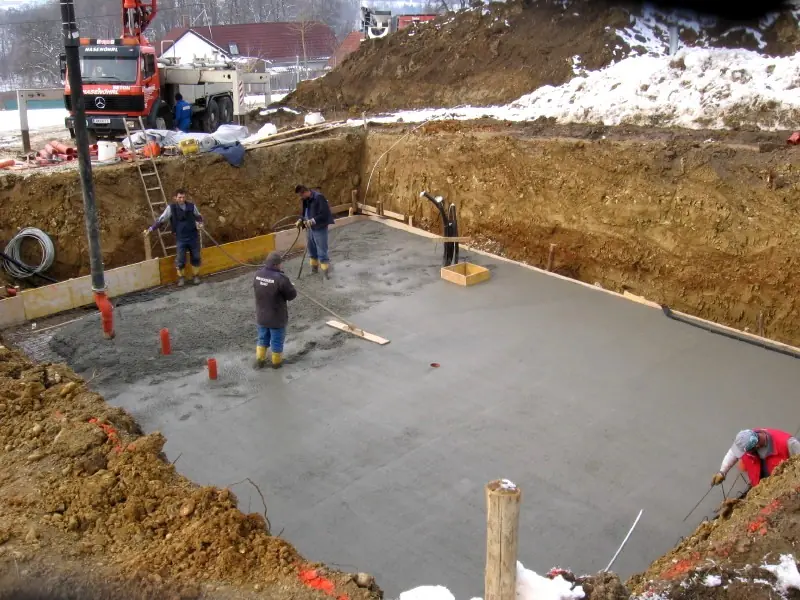 A basement concrete pour, photographed in 2006, illustrates conventional construction.
H. Raab / Wikimedia Commons, CC BY-SA 3.0.
A basement concrete pour, photographed in 2006, illustrates conventional construction.
H. Raab / Wikimedia Commons, CC BY-SA 3.0.

The Chemistry Behind Cement’s Carbon Footprint
Cement and concrete are different materials. Cement is the binding powder that reacts with water; concrete combines that binder with sand and larger pieces of stone. Conventional Portland cement depends on clinker, an intermediate material produced in a kiln at temperatures around 1,450°C and then ground with other ingredients.[2]
Making clinker requires calcium, commonly supplied by limestone. When heated, limestone’s calcium carbonate breaks down into calcium oxide, or lime, and CO₂. These chemical emissions are often called process emissions. Fuel burned to provide the heat releases additional carbon dioxide. UCLA’s October explanation attributed roughly 60% of emissions in the conventional process to limestone decomposition and the remaining 40% to kiln fuel.[1]
Cleaner energy can reduce emissions from heating a kiln, but limestone still releases carbon as it changes chemically. Improving energy efficiency alone therefore cannot eliminate the footprint. Further reductions require less clinker, another production route or a way to capture the CO₂ before it enters the atmosphere.
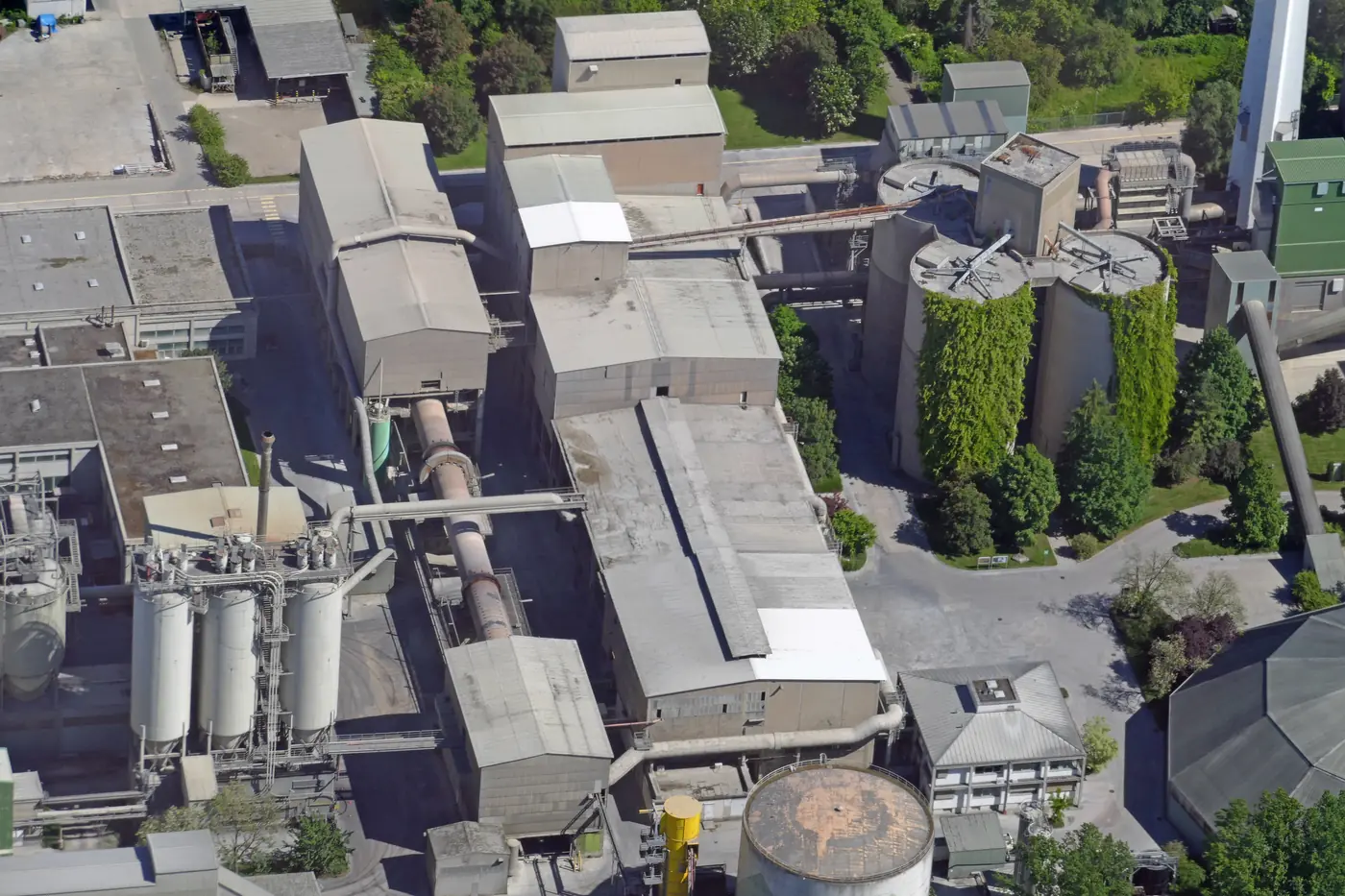 The Leimen cement works in Germany, photographed in 2019. The rotary kiln is visible between the buildings on the left.
Rolf Kickuth / Wikimedia Commons, CC BY-SA 4.0.
The Leimen cement works in Germany, photographed in 2019. The rotary kiln is visible between the buildings on the left.
Rolf Kickuth / Wikimedia Commons, CC BY-SA 4.0.

Reducing the Clinker in the Mix
Some clinker can be replaced with supplementary materials such as fly ash, ground blast-furnace slag, limestone and calcined clay. Treating clay requires lower temperatures than producing clinker and, except where carbonate impurities occur, avoids the decomposition emissions characteristic of limestone.[2] These materials reduce how much clinker is needed to make a useful binder.
Blended cement was already being used widely. The Portland Cement Association reported in an October release that blends accounted for about half of U.S. cement consumption in 2023.[3] This describes how much was being used, not a halving of emissions. The savings depend on the ingredients and the methods used to produce them.
The practical challenge is to reduce clinker while retaining the properties a structure needs. A paper published on 23 October tested a combination of Portland cement, calcined clay, limestone and blast-furnace slag. Its optimised concrete mixture reached a compressive strength of 42.8 megapascals after 28 days, demonstrating useful strength in that particular formulation.[4] Such results give manufacturers evidence to build on, while leaving further questions about performance across different materials and applications.
The mixture also affects the footprint of newer construction methods. On 25 October, the University of Virginia reported a printable composite made with limestone, calcined clay and graphene. A life-cycle assessment estimated approximately 31% lower greenhouse-gas emissions than the traditional printable mixtures used for comparison.[5] Since the estimate applies to that particular material system and comparison, it cannot be claimed for every printed concrete building.
A Different Route From Limestone to Lime
Even when less clinker is used, producing the remaining clinker still releases emissions. ZeroCAL, described in a paper published on 10 October, addressed the way limestone supplies calcium. It dissolves limestone in a solution, separates calcium from dissolved bicarbonate through membranes and uses electrochemical steps to produce calcium hydroxide.[6]
Calcium hydroxide can then supply lime for cement production. When heated, it releases water, avoiding the CO₂ released when limestone is heated directly.[1] The original carbon remains in a separate stream, principally as dissolved bicarbonate, whose management is part of the process.[6]
The researchers reported potential reductions of more than 98% in process CO₂ emissions, but this applied to the lime-production pathway they analysed. It did not represent the whole footprint of a cement plant or building. They also estimated that total energy demand would be roughly twice that of conventional lime manufacturing.[6]
Since the process uses more energy, access to low-carbon electricity would strongly affect its environmental benefit. UCLA identified water demand and higher energy use as practical challenges.[1] The research available in October 2024 supported a possible route to cleaner production, while commercial-scale performance remained to be established.
Capturing Emissions From Existing Production
Existing plants can also pursue carbon capture and storage: separating CO₂ before it enters the atmosphere and sending it to permanent storage. The UK government’s 4 October announcement described storing captured industrial emissions beneath the seabed and made up to £21.7 billion available over 25 years for carbon capture and hydrogen clusters.[7]
For a cement plant to use carbon capture, it needs a place to send the CO₂ as well as equipment to separate it. The announced clusters could provide that infrastructure, which is why Heidelberg Materials welcomed the decision. Its proposed Padeswood capture project, near Mold in north Wales, was part of the HyNet cluster.[8]
The proposed facility was designed to capture up to 800,000 tonnes of CO₂ a year and send it through a pipeline to storage beneath Liverpool Bay.[8] As of October 2024, these capabilities were still planned. The equipment, transport network and storage facilities would all have to operate together to achieve the projected reductions.
Building With Less New Concrete
Reducing demand for newly manufactured material also involves looking at concrete already in use. In an article published on 29 October, EPFL researcher Maxence Grangeot explained that crushing demolished concrete into recycled aggregate may leave much of the footprint unchanged, because making replacement concrete can still require as much new cement.[9]
Reusing larger pieces preserves more of the original material’s value. Grangeot pointed to EPFL’s Re:Crete footbridge, assembled from concrete blocks recovered from an old building, as an example of reuse beyond crushing rubble. Maintaining existing structures and extending their useful lives can likewise reduce demand for replacement material.[9]
Decisions about building design therefore affect how much cleaner production can achieve. A project team can examine which parts of a structure can be retained, how much material is required and whether lower-clinker mixtures meet those needs. Standards and testing remain necessary to make these choices safely.[2]
Before choosing a new material, a building owner can consider whether the existing structure could be repaired or adapted. Doing so may avoid a substantial new pour, along with the cement that would have to be manufactured for it.
Sources
- UCLA engineers develop scalable process to decarbonize cement production
- GCCA Policy Document on Blended Cements and Supplementary Cementitious Materials
- U.S. Cement Industry Hits Energy Efficiency Milestones
- Studies on hybrid quaternary blended limestone calcined clay cement (LC3) for sustainable concrete
- Advancement in 3D-Printed Concrete Promises Strength, Durability and Lower Carbon Emissions
- ZeroCAL: Eliminating Carbon Dioxide Emissions from Limestone’s Decomposition to Decarbonize Cement Production
- Government reignites industrial heartlands 10 days out from the International Investment Summit
- Government’s announcement reaffirming commitment to carbon capture and storage cluster projects is a big step towards zero carbon cement
- Is green concrete a myth?