Carbon Credits and the Challenge of Proving Real Emissions Cuts
Protecting a forest can help the climate, but claiming that the payment compensates for emissions somewhere else requires more explanation. The trees might have remained standing without the money, logging could move to…
Protecting a forest can help the climate, but claiming that the payment compensates for emissions somewhere else requires more explanation. The trees might have remained standing without the money, logging could move to another area, or a later fire could release the carbon that was meant to stay stored.
Carbon credits are intended to direct money toward additional climate action. To judge whether they do so, we have to ask how much a funded activity changes the greenhouse gas reaching the atmosphere. Even a valuable project can provide fewer emissions savings than the credits issued for it claim.
What Carbon Credits Are Supposed to Deliver
A carbon credit generally represents one metric tonne of carbon dioxide, or an equivalent amount of another greenhouse gas, reduced, avoided or removed. Companies and individuals can purchase credits to support projects elsewhere and use them to compensate for their own emissions. When a credit is used for such a claim, it is retired, taking it out of circulation so it cannot be used again.[1]
Protecting a threatened forest can prevent carbon from being released, whereas establishing woodland can remove carbon dioxide from the air as the trees grow. Both can help the climate, but they do different things: one avoids a future emission and the other withdraws carbon already in the atmosphere. At net zero, continuing emissions must be balanced by removals, making this difference especially relevant.[2]
Either kind of project must demonstrate that its intervention caused the credited benefit before that benefit can support an offset claim. Observing the project site alone is not enough to establish this.
The Emissions That Would Have Happened
Additionality asks whether a reduction or removal would have happened without the incentive of carbon-credit revenue. If the activity would have gone ahead anyway, issuing credits does not provide an extra climate benefit for the buyer to claim.[3]
For a forest-protection project, additionality involves estimating how much forest would have been lost without intervention. That estimate becomes the baseline for calculating avoided emissions. Satellite images can show the forest that remains, but they cannot show directly what would have happened if the project had never existed.
Consider a simplified hypothetical example. A project predicts that clearing would release 10,000 tonnes of carbon dioxide and then prevents all clearing. Against that baseline, it could claim 10,000 tonnes of avoided emissions. But if only 2,000 tonnes would realistically have been released, the same protected forest supports a much smaller claim. The difference comes entirely from the starting assumption.
This problem has appeared in real evaluations. A 2023 study used comparisons with areas outside the projects to assess 26 forest-conservation project sites across six countries. Most did not show a statistically significant reduction in deforestation; where reductions were detected, they were substantially smaller than claimed. The findings exposed weaknesses in project baselines, although the researchers’ alternative estimates also depended on constructing credible comparisons.[4]
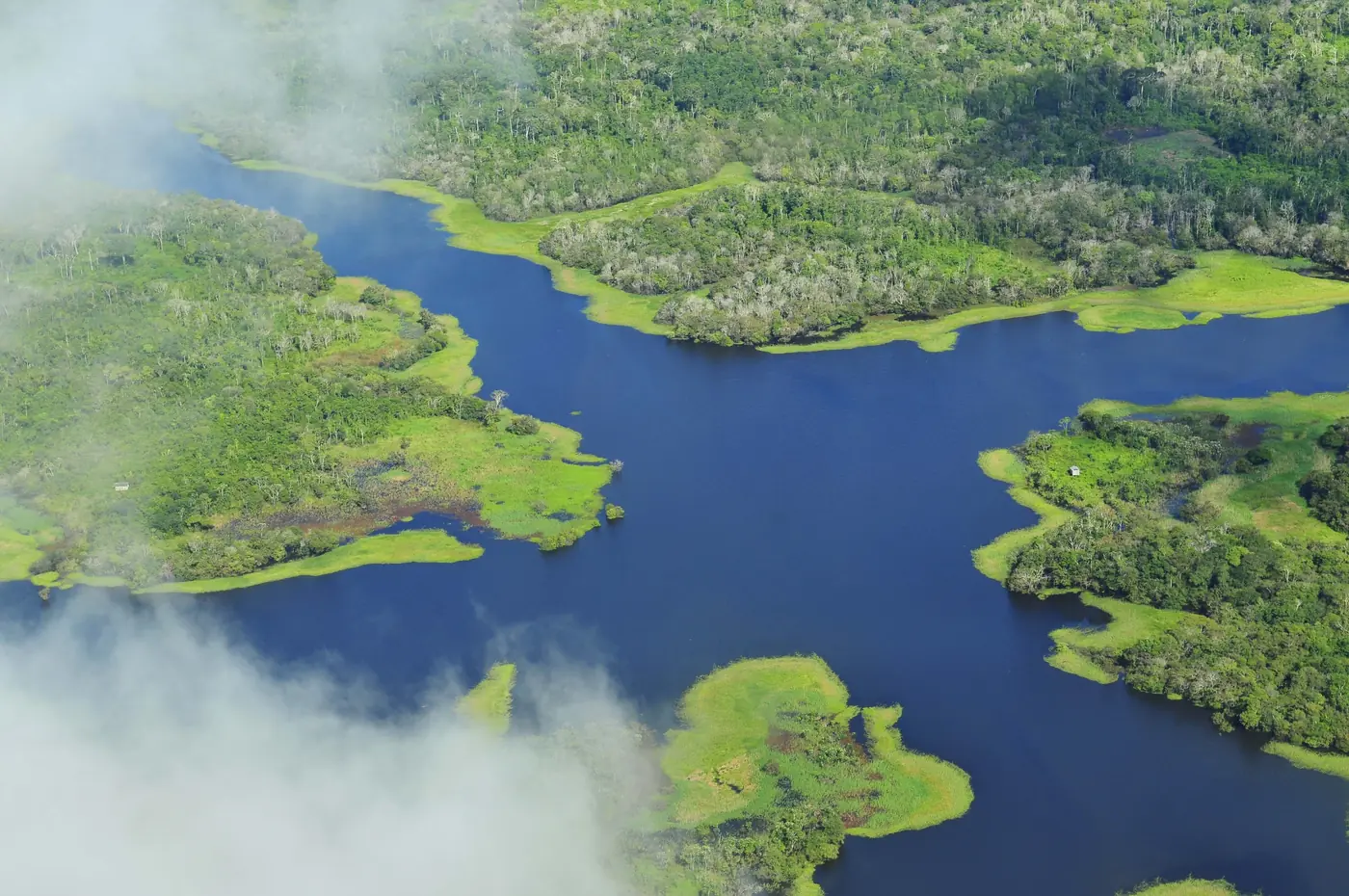 Amazon rainforest near Manaus, Brazil. This photograph illustrates the forest landscape; it does not identify a project evaluated in the study.
Credit: Neil Palmer / CIAT / CC BY-SA 2.0.
Amazon rainforest near Manaus, Brazil. This photograph illustrates the forest landscape; it does not identify a project evaluated in the study.
Credit: Neil Palmer / CIAT / CC BY-SA 2.0.

The Gap Between Estimates and Results
A defensible baseline still has to be followed by measurements of what happens in practice. For example, a cookstove that uses less fuel in a laboratory may save a different amount in a household. Cooking habits, fuel choices and continued use of an older stove all affect the fuel actually consumed.
Simply counting distributed stoves cannot establish how much fuel was displaced or how many emissions were avoided. Calculations also depend on whether harvested wood would have regrown. Saving wood that would otherwise regenerate has a different carbon consequence from reducing an unsustainable harvest.
A January 2024 analysis of five cookstove-crediting methodologies estimated that its sample of projects received about 9.2 times as many credits as their emissions savings justified. Assumptions about biomass, adoption and fuel use contributed to the discrepancy. A methodology that directly monitored fuel use came considerably closer to the researchers’ estimates, showing why the measurement approach matters.[5]
 Improved cookstove production in Cambodia. The photograph is illustrative and is not identified with the projects assessed above.
Credit: Sheepad / Wikimedia Commons / CC BY-SA 3.0.
Improved cookstove production in Cambodia. The photograph is illustrative and is not identified with the projects assessed above.
Credit: Sheepad / Wikimedia Commons / CC BY-SA 3.0.

The concern extended beyond one project type. A review published in November 2024 brought together 14 studies covering 2,346 carbon-crediting projects. Its authors estimated that less than 16% of the credits covered by the analysis represented real emissions reductions. Their analysis covered roughly one-fifth of credits issued across the mechanisms examined.[6]
The review provides a substantial warning, although it does not establish that the same proportion of all credits on the market is ineffective. Projects and methodologies varied, and only available evaluations could be included. Because large discrepancies occurred across several project types, the way crediting methods are designed deserves close attention.
Carbon That Moves or Returns
Even a project that prevents clearing within its boundaries can cause some of that clearing to move elsewhere. This displacement is called leakage. When the wider area is considered, the emissions caused elsewhere have to be deducted from the project's benefit.[3]
Forest carbon can also return to the atmosphere if trees burn, die during drought or are harvested later. This is the problem of permanence: a buyer may already have used credits to make an emissions claim before the stored carbon is released. A short storage commitment cannot match the duration of fossil-fuel emissions, whose climate effects persist long after that commitment ends.
To manage this risk, some programmes require projects to contribute a share of credits to a common reserve called a buffer pool. Credits from the reserve can be cancelled to compensate for later losses. How well the arrangement protects against those losses depends on whether enough credits have been set aside.
An assessment of California's forest-offset programme published in 2022 estimated that wildfire losses through 2021 equalled at least 95% of the credits contributed to cover fire risk over 100 years. That was the wildfire allocation, not 95% of the entire pool. The finding showed why a long storage commitment requires a realistic assessment of future losses, as well as evidence about carbon stored at the outset.[7]
A Tonne Counted Once
Even a real reduction that lasts can be overstated if it is claimed more than once. Registries assign unique identifiers to credits and record when they are issued and retired. They also have to prevent duplicate credits being issued for the same underlying reduction.[3]
International transfers introduce a separate accounting problem. If one country sells a reduction for another country to count towards its climate target, both cannot claim that same reduction towards their national targets. Under the Paris Agreement's Article 6 framework, corresponding adjustments reconcile the countries’ accounts to prevent this overlap.[8]
Corresponding adjustments settle which country counts the transferred benefit, but they do not establish whether the project caused it. Both reliable accounting and evidence of the project's effect are required; resolving one does not resolve the other.
Stronger Rules, Better Evidence
By November 2024, efforts to improve credit quality were targeting these weaknesses. The Integrity Council for the Voluntary Carbon Market's Core Carbon Principles called for conservative calculations, independent verification and public information that allows scrutiny. Their safeguards also addressed environmental and social impacts, recognising that carbon accounting alone cannot establish a project's acceptability.[3]
Applying stronger criteria can change which credits qualify. In August 2024, the council announced that eight existing renewable-energy methodologies would not receive its quality label because their additionality tests were insufficiently rigorous. The issue was whether projects needed the carbon-credit incentive to proceed; the decision did not question the climate value of expanding renewable energy.[9]
International rules advanced at COP29 in November. Countries agreed further provisions for trading under Article 6.2 and standards for the UN-supervised Article 6.4 crediting mechanism. These included arrangements for authorisation, tracking and safeguards, while substantial implementation work remained.[10]
A buyer therefore has to look beyond a standard's name. The claim needs evidence linking the particular project to its baseline and measured results, along with arrangements for handling later losses.
Climate Finance and Climate Claims
The way buyers use credits matters alongside the quality of projects. Oxford's revised offsetting principles, published in 2024, put cutting an organisation's own emissions first. They also called for a transition towards carbon removals, with durable storage, to balance residual emissions at net zero.[2]
Forest conservation and other useful climate activities can still be funded now, provided the claims about that funding are precise. Supporting a project demonstrates a contribution to its work. Claiming compensation for a tonne emitted elsewhere goes further, requiring evidence of an equivalent additional climate benefit.
If the impact remains uncertain, both purchasing decisions and public claims should reflect that uncertainty. Valuable climate work can receive funding without its estimated effect being presented as a proven cancellation of emissions.
Sources
- What are carbon markets and why are they important?
- Oxford Principles for Net Zero Aligned Carbon Offsetting (revised 2024)
- Core Carbon Principles, Assessment Framework and Assessment Procedure
- Action needed to make carbon offsets from forest conservation work for climate change mitigation
- Pervasive over-crediting from cookstove offset methodologies
- Systematic assessment of the achieved emission reductions of carbon crediting projects
- California’s forest carbon offsets buffer pool is severely undercapitalized
- What You Need to Know About Article 6 of the Paris Agreement
- Carbon credits from current renewable energy methodologies will not receive high-integrity CCP® label
- COP29 UN Climate Conference Agrees to Triple Finance to Developing Countries, Protecting Lives and Livelihoods